This crochet dragonfly keychain pattern makes a light, pocket-sized accessory with a softly shaped body and four simple leaf-shaped wings. The body is worked in the round, the wings are made flat in rows, and a reinforced yarn loop connects the finished piece to a split ring.
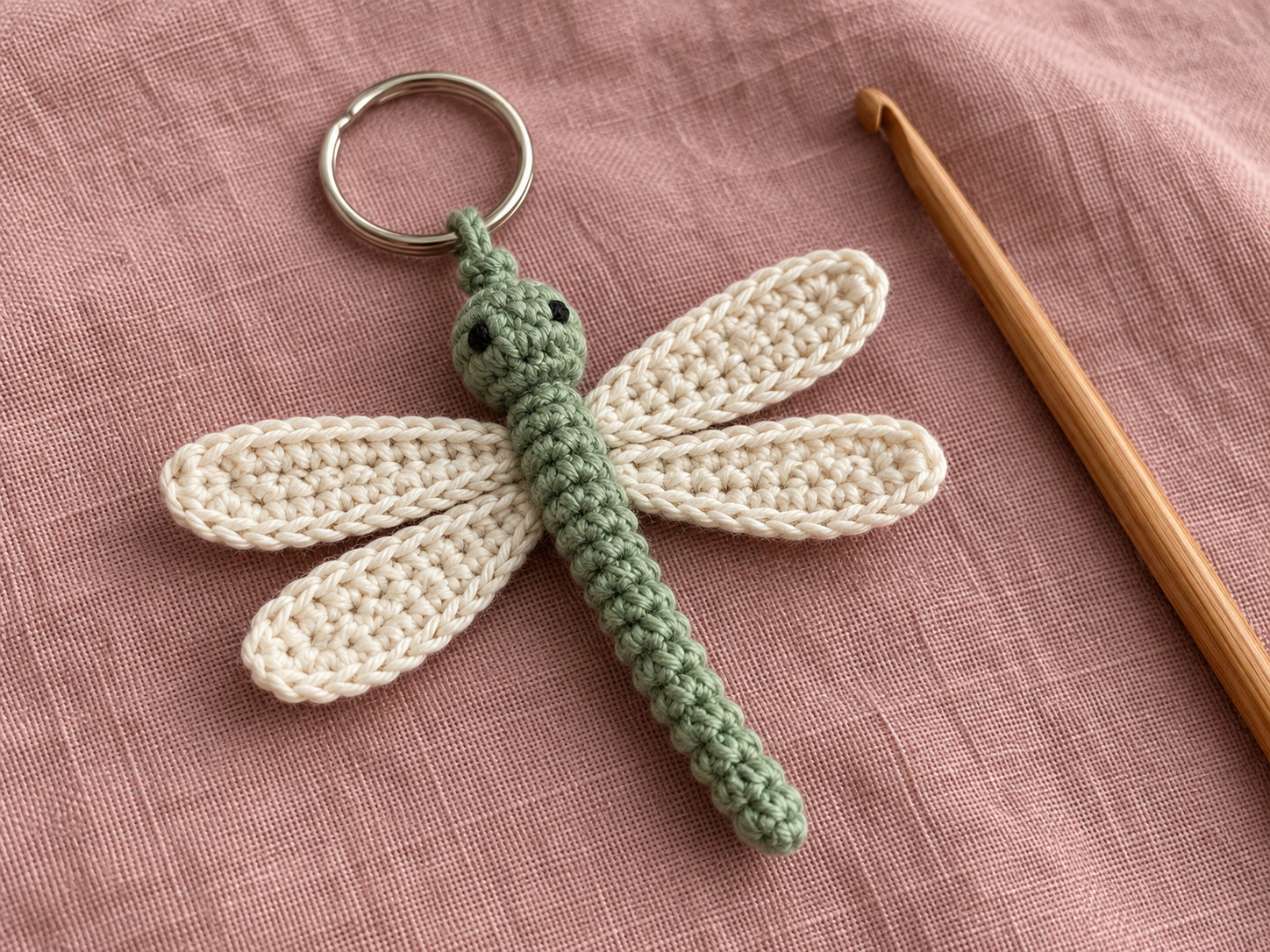
Materials
- DK/light worsted cotton yarn: about 15 g sage green for the body and hanging loop, plus about 10 g ivory for four wings
- 2.75 mm crochet hook, or a size that gives a firm fabric
- One small metal split ring, approximately 18–20 mm
- A small amount of washable toy stuffing
- Tapestry needle, scissors, stitch marker, and a short strand of dark embroidery thread
This is a compact accessory rather than a toy. Check the ring and every sewn join before use; keep metal hardware and small parts away from children under three.
Abbreviations (US terms)
| Abbreviation | Meaning |
|---|---|
| MR | magic ring |
| ch | chain |
| sc | single crochet |
| inc | 2 sc in the same stitch |
| dec | single-crochet decrease over 2 stitches |
| sl st | slip stitch |
| st(s) | stitch(es) |
Work the body in continuous rounds; use a marker to show the first stitch. The turning chain on each wing row does not count as a stitch. Stitch counts appear in parentheses.
Pattern
Body — make 1
- Round 1: With sage yarn, make 6 sc in an MR. (6)
- Round 2: Inc in each st around. (12)
- Round 3: Repeat (sc, inc) 6 times. (18)
- Rounds 4–5: Sc in each st around. (18 each round)
- Round 6: Repeat (sc, dec) 6 times. (12)
- Add a little stuffing to the rounded head.
- Round 7: Repeat (sc, dec) 4 times. (8)
- Rounds 8–16: Sc in each st around. (8 each round)
- Add a small amount of stuffing to the narrow body. Flatten the opening so the last 8 stitches form 4 pairs, then sew through both layers to close. Fasten off, leaving a tail for attaching the wings.
Wings — make 4
With ivory yarn, ch 8. Turn after each row; ch 1 at the beginning of each row, and do not count it as a stitch.
- Row 1: Sc in the 2nd ch from the hook and in each remaining ch. (7)
- Row 2: 2 sc in the first st, sc in the next 5 sts, 2 sc in the last st. (9)
- Row 3: 2 sc in the first st, sc in the next 7 sts, 2 sc in the last st. (11)
- Row 4: Sc in each st across. (11)
- Row 5: Sc2tog, sc in the next 7 sts, sc2tog. (9)
- Row 6: Sc2tog, sc in the next 5 sts, sc2tog. (7)
- Row 7: Sl st loosely in each st across. (7)
Fasten off and weave in the starting end. Leave a long sewing tail on each wing. Make four matching pieces.
Finishing and assembly
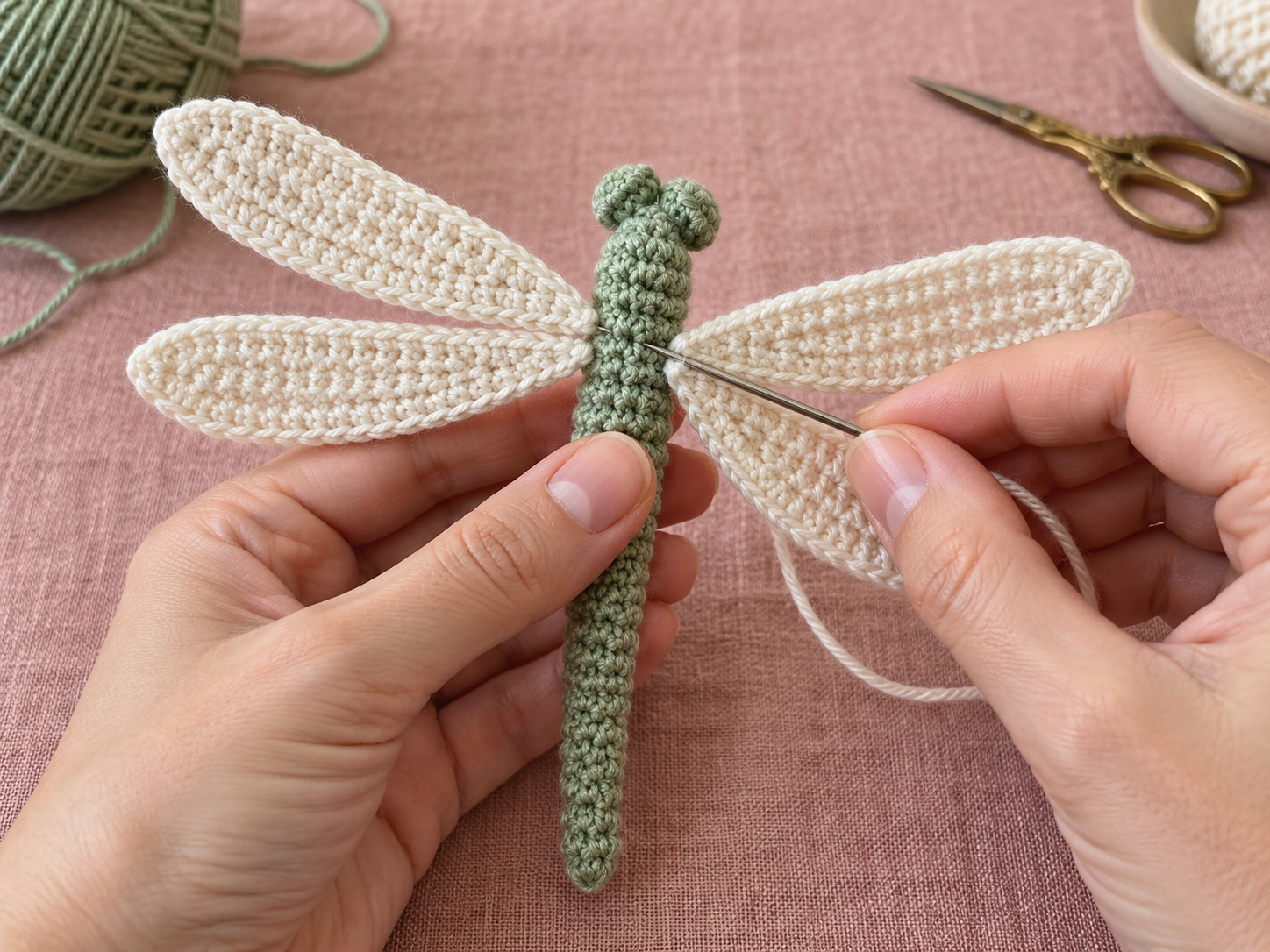
- Arrange two wings on each side of the body, with one pair near the head and the other pair a little lower. Let the narrow ends overlap slightly at the center.
- Using each wing’s yarn tail, sew its base securely to the body with several small passes. Weave the tail into the body and trim only after checking the join.
- Embroider two tiny eyes on the rounded head with dark thread. Knot and bury the ends inside the fabric.
- With sage yarn, ch 12. Pass the chain through the split ring, then sew both ends firmly to the top of the head. Make several passes through the body fabric and hide the yarn ends inside.
- Gently shape the wings with your fingers. Check that all four wing bases and the ring loop are secure before using the keychain.
Care
Spot-clean gently with cool water and mild soap, then press in a towel and air-dry flat. Remove the metal ring before washing if its finish is not water-safe.
FAQs
Can I use a different yarn weight?
Yes. A heavier yarn and a proportionally larger hook make a larger keychain; a finer yarn makes a smaller one. Keep the hook small enough for a firm body fabric so stuffing does not show.
Can I make the wings in different colors?
Yes. Use one shade for the upper pair and another for the lower pair, or work all four in one color. Keep the same row counts so the pieces remain a balanced set.
How do I keep the keychain from coming apart?
Sew the ring loop directly through the firm top of the body with multiple passes, and secure each wing base through both the wing and body fabric. Recheck the joins periodically with everyday use.
This is an independently written Blanchef pattern with new instructions and original images. The third-party source retains rights to its own text and photographs. View the referenced Penguin Hobbies page.