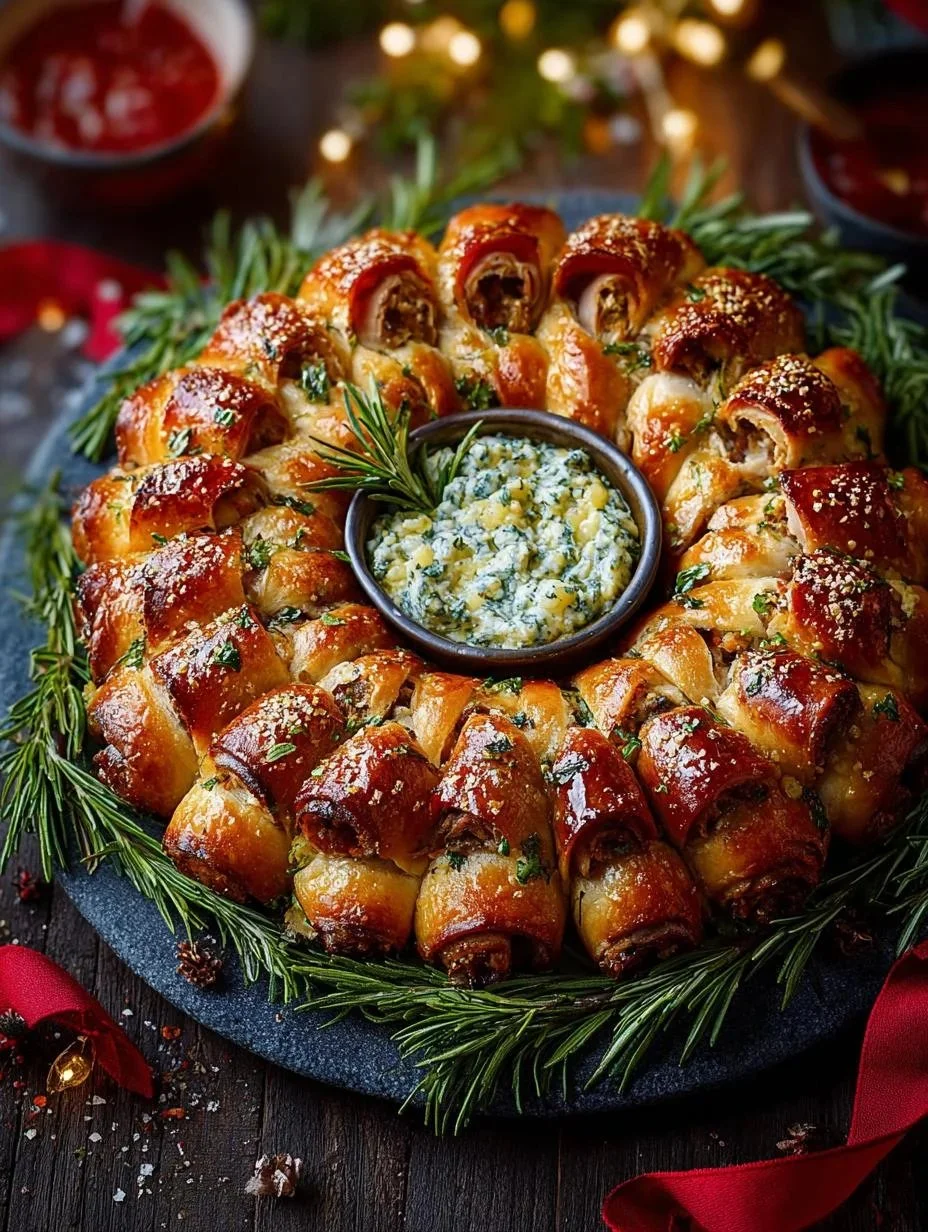
Traditional Pigs Blanket Wreath guide
A warm, savory centerpiece that doubles as an easy party platter—there’s something quietly brilliant about a pigs-in-a-blanket wreath. This guide walks you from the first unrolled sheet of dough to a confident, repeatable holiday-ready ring. Read on and you’ll gain practical skill, creative options, and the historical context that makes this recipe a crowd-pleasing classic.
What you’ll get from this guide:
- A clear understanding of the dish and its roots.
- Step-by-step, time-estimated instructions for beginner → advanced outcomes.
- Tools, troubleshooting, and pro tips to refine texture, flavor, and presentation.
- Variations and adaptations to match diet, occasion, or scale.
If you’ve ever wanted to make a show-stopping appetizer that’s approachable and flexible, this Traditional Pigs Blanket Wreath guide is your playbook.
Background & Context
Pigs-in-a-blanket are a widespread comfort-food idea: small sausages wrapped in dough and baked until golden. Their appeal sits where savory, handheld convenience meets universal familiarity.
Classic Pigs Blanket Wreath history traces a simple culinary idea into festive form. Wrapping sausages in dough is found in many cultures: kipferl-like pastries in Europe, cocktail sausage rolls in Britain, and regional hot dog pastries in the U.S. The wreath format is a modern twist that turns many small bites into a communal centerpiece.
Authentic Pigs Blanket Wreath origin is less about a single inventor and more about communal adaptation. The transformation into a ring likely comes from holiday table aesthetics—wreaths symbolize celebration and abundance—and the practical desire to bake many pieces together.
Practically, a wreath bakes evenly, requires fewer trays, and looks impressive with minimal skill. Observationally, hosts report the wreath is the first platter to empty at gatherings, making it both a decorative and functional success.
Why This Approach Works
Making a wreath instead of separate rolls brings three core benefits:
- Visual impact: A single large ring reads as festive and intentional.
- Efficiency: One assembled ring uses heat more uniformly and reduces handling.
- Shareability: Guests can tear or cut portions from a central shape, encouraging interaction.
Accessibility: The recipe adapts to premade dough and pre-cooked sausages for a beginner-friendly route.
Flexibility: You can scale the wreath for small family dinners or large parties with proportional ingredient adjustments.
Addressing doubts:
- “Will it be dry?” Not if you manage dough thickness, brush with egg wash, and monitor bake time.
- “Is this just for holidays?” No—wreath form works for game nights, picnics, and casual dinners.
- “Do I need special equipment?” No—basic baking sheet and a rimmed round pan or template will do.
Core Concepts Explained
Break the recipe into logical components so you understand why each step matters.
- Dough
- Concept: Dough is the protective, flavor-bearing shell. Thickness controls crispness and proportion of bread-to-sausage.
- Examples: Puff pastry yields flaky, layered texture; crescent or biscuit dough gives softer, bready results.
- Alternatives: Refrigerated crescent roll dough for ease; homemade enriched dough for a more artisanal bite.
- Filling (Sausage)
- Concept: The sausage provides the savory center; its seasoning and moisture content affect final flavor.
- Examples: Cocktail wieners, mini bratwurst, or sliced frankfurters.
- Substitutions: Vegetarian sausages or seasoned tofu strips for plant-based options.
- Assembly & Structure
- Concept: A stable wreath requires even-size pieces and a secure overlap to prevent gaps and leaks.
- Examples: A continuous spiral, individual wrapped pieces arranged and baked together, or a braided ring for stability.
- Finish (Egg wash, glazes, toppings)
- Concept: Surface treatments control browning and add flavor/texture.
- Examples: Egg wash for gloss, sesame seeds for nuttiness, honey-mustard glaze for sweet-sour balance.
- Simplifications: Butter brush instead of egg if allergic.
- Baking Profile
- Concept: Oven temperature and baking time control crust color and sausage heat-through.
- Examples: Higher heat for quick browning; lower+longer for even bake if dough is thick.
Understanding these components lets you adapt the wreath without guessing.
Tools, Resources, or Foundations
Essentials:
- Baking sheet (rimmed) or pizza stone.
- Rimmed round pan or a ring template (can use a foil-wrapped bowl).
- Rolling pin (or use hands for pre-formed dough).
- Pastry brush for washes.
- Sharp knife or pizza cutter.
Optional enhancements:
- Silicone baking mat for non-stick surface.
- Baking stone for crisper bottom crust.
- Pastry wheel for decorative edges.
Budget-friendly / beginner alternatives:
- Use store-bought crescent or puff pastry.
- Replace pastry brush with a clean finger for small brushes.
- Form a ring directly on a baking sheet; you don’t need a special pan.
Commentary on usefulness:
Essentials get the job done; optional tools add polish and speed. Prioritize accuracy in measurements over fancy equipment.
Step-by-Step Process
Overview: Prep → Assemble → Bake → Finish. Total active time: 30–50 minutes. Total elapsed time: 40–70 minutes depending on dough and chill times.
- Plan & Prep (10–15 minutes)
- Choose dough and sausages.
- Preheat oven 375–400°F (190–205°C) depending on dough type.
- Line baking sheet and set ring template if using.
- Pre-cooking (optional, 5–10 minutes)
- If using raw sausages, parboil or pan-cook briefly. Cocktail sausages typically do not require pre-cooking.
- Cooling prevents steam pockets and sogginess.
- Dough Handling (10–15 minutes)
- Roll dough to even thickness. Aim for 1/8–1/4 inch for puff or crescent dough; slightly thicker for biscuit dough.
- Cut dough into uniform rectangles or strips to wrap sausages.
H3: Assembling the Wreath (20–30 minutes)
- Method A — Individual wrapped pieces:
- Wrap each sausage in dough, seam side down.
- Arrange wrapped sausages in a ring touching slightly to form a continuous circle.
- Press seams between adjacent rolls to create continuity.
- Method B — Spiral/continuous braid:
- Roll dough into a long rope, lay out sausages in a line and wrap or braid around them, join ends to form a ring.
- Time estimate: 15–25 minutes depending on skill and number of pieces.
H3: Surface Finish & Baking (15–25 minutes)
- Brush with egg wash (1 egg + 1 tbsp water) for shine and deeper color.
- Add toppings: sesame seeds, poppy seeds, or grated cheese.
- Bake: Puff pastry at 400°F for 18–22 minutes; crescent dough at 375°F for 20–25 minutes. Adjust time until dough is golden and sausages are heated through.
- Allow to rest 5–10 minutes before slicing or serving.
Common mistakes and how to avoid them:
- Overly thick dough: makes the bite dough-heavy — roll thinner.
- Under-baked center: rotate the sheet and check internal temp; reduce top heat if crust browns too fast.
- Seams opening: seal seams with a little water or egg wash and press firmly.
Pro tips:
- Dock (poke) the dough lightly around sausages to release steam if using very moist sausages.
- For crisp bottoms, bake on a preheated baking stone or use a lower rack position.
- Assemble chilled: keep dough and sausages cool to avoid slack dough.
Expert Techniques & Insights
- Layer control with puff pastry:
- Partially thawed puff pastry separates into layers when baked. Work with dough that’s pliable but still cool.
- Chill the assembled wreath 10–15 minutes before baking to reduce spreading and improve lift.
- Flavor infusions:
- Brush with garlic-herb butter immediately after baking to melt into the crust.
- Sprinkle flaky salt after baking for textural contrast.
- Structural integrity:
- Create a "key" seam by tucking the end of a strip under the first piece for a seamless ring.
- If using raw sausages, score tiny vents into dough near sausages to prevent bursts.
- Baking consistency:
- Use an oven thermometer to ensure true temp. Many home ovens run hot or cold, impacting browning.
- Rotate halfway through baking for even color.
Lessons from experience:
- Uniform sausage size is more important than uniform dough pieces. Balancing the ratio of bread to filling determines the eating experience.
- A little char on edges is a flavor upgrade; avoid full-on burning.
Variations & Adaptations
Different contexts and use cases:
- Holiday Wreath: Add red pepper confetti and fresh herbs in the center; brush with egg wash and dust with paprika.
- Game-Day Ring: Add cheddar and jalapeño inside some wraps for heat.
- Brunch Version: Use breakfast sausages and maple glaze.
Skill-level adaptations:
- Beginner: Use refrigerated crescent dough and cocktail wieners. Easy assembly, minimal technique.
- Intermediate: Work with store-bought puff pastry and make a braided ring.
- Advanced: Make enriched brioche or laminated dough from scratch, pair homemade sausages, and control steam vents.
Dietary flexibility:
- Vegetarian/vegan: Use plant-based sausages and dairy-free pastry. Use aquafaba or non-dairy milk for wash.
- Gluten-free: Use a firm gf pastry that holds shape, or assemble smaller rolls to bake more easily.
Cultural flexibility:
- Mediterranean: Fill with merguez-style spiced sausages and harissa glaze.
- Scandinavian: Use spiced meatballs wrapped in cardamom-scented dough with lingonberry dipping sauce.
Analysis & Benefits Breakdown
Below is a structured comparison to help you decide which approach fits your needs.
| Approach | Time | Ease | Texture | Visual Impact | Best Use |
|—|—:|—:|—:|—:|—|
| Crescent dough, cocktail sausages | 30–40 min | Very easy | Soft, slightly flaky | Good | Quick parties, beginners |
| Puff pastry, mini sausages | 40–60 min | Moderate | Flaky, layered | Very impressive | Holiday centerpiece |
| Homemade brioche + artisanal sausages | 4+ hrs | Advanced | Rich, tender | Showstopper | Special occasions |
| Gluten-free dough + vegan sausages | 45–75 min | Moderate | Varies | Good | Dietary-restricted guests |
| Braided or continuous wrap | 40–70 min | Moderate | Even texture | Elegant | Dinners needing presentation |
Strengths:
- High shareability.
- Highly adaptable to flavor profiles and diets.
- Can be made mostly ahead of time.
Limitations:
- Presentation depends on uniformity and baking consistency.
- Some variations require skill or time (homemade dough).
- Overly thick dough can dominate the bite.
Considerations:
- Ingredient quality matters. A higher-quality sausage makes a big difference.
- Scale proportionally: doubling servings requires more space and careful thermal management.
Preparation, Retention & Long-Term Use
How to prepare effectively:
- Read the entire recipe before starting and preheat the oven early.
- Prep mise en place: line up dough, sausages, wash, toppings, and tools.
- Use a template for consistent size if you intend to reproduce results.
Retention or reuse strategies:
- Make-ahead: Assemble the ring, cover tightly, and refrigerate up to 24 hours before baking.
- Freeze: Bake fully, cool, and freeze individual wedges. Reheat in oven 350°F for 10–15 minutes until warmed through.
- Leftovers: Refrigerate for up to 3 days. Reheat in oven or air fryer for crispness.
Longevity of knowledge or skills:
- The skills learned—dough handling, ratio control, and surface finishes—translate to other pastries and savory pies.
- Once you master assembly and bake control, you can scale, flavor-shift, and improvise confidently.
Troubleshooting & Common Problems
Problem → Cause → Solution format to keep it practical.
Problem: Dough is soggy in the center.
- Cause: Moisture from sausage or filling released; dough too thick preventing evaporation.
- Solution: Pre-cook sausages slightly; dock dough; bake longer at slightly lower temperature to allow internal moisture to escape; use drier sausages.
Problem: Seams pop open while baking.
- Cause: Poor sealing or overly full dough pockets.
- Solution: Seal seams with egg wash or water; use smaller dough pieces per sausage; chill assembled wreath before baking.
Problem: Bottom is under-browned while top is perfect.
- Cause: Oven rack too high or uneven heat distribution.
- Solution: Move to a lower rack; preheat a baking stone; finish on the bottom rack for a few minutes.
Problem: Uneven browning around the ring.
- Cause: Oven hot spots or ring not centered.
- Solution: Rotate pan halfway; use an even circular pan; check oven calibration.
Problem: Pastry didn’t rise/layer as expected (puff pastry).
- Cause: Over-handling, too warm, or fully thawed pastry.
- Solution: Handle minimally; keep pastry chilled; rest in fridge before baking.
Problem: Wreath collapsed / lost shape.
- Cause: Dough overstretched or not chilled; too much filling weight.
- Solution: Use slightly thicker band or additional stitch points to support; chill before baking.
These quick fixes help you recover mid-bake or adjust for next attempts.
FAQ
Q1: Can I assemble the wreath ahead of time?
A1: Yes—assemble and refrigerate up to 24 hours before baking. Cover tightly to prevent drying.
Q2: Which dough gives the best texture?
A2: Puff pastry for flaky layers; enriched dough for tender, rich breadiness. Crescent dough is quickest.
Q3: Do sausages need pre-cooking?
A3: Cocktail sausages usually do not. Larger raw sausages benefit from partial cooking to avoid underdone centers.
Q4: How do I keep the bottom crisp?
A4: Use a preheated baking stone or lower oven rack. Avoid excess moisture and ensure even dough thickness.
Q5: What’s a good dipping sauce pairing?
A5: Mustard (Dijon or honey-mustard), barbecue, or a tangy ketchup-based glaze complement the wreath.
Q6: Can I make a savory and sweet combination?
A6: Yes—try maple-glazed breakfast sausages with a light dusting of powdered sugar for brunch novelty.
Q7: How many people does one wreath serve?
A7: A standard wreath (approx. 20–24 small rolls) serves 8–12 as an appetizer, depending on appetite and sides.
Q8: Any tips for gluten-free versions?
A8: Use a sturdy gluten-free pastry formulated to hold shape; keep pieces small to avoid collapse; watch bake times closely.
Related Topics & Next Steps
Logical extensions of learning:
- Homemade sausage recipes and seasoning blends.
- Laminated dough basics for making puff pastry from scratch.
- Party platter assembly and sauce pairings.
- Bread shaping and braiding techniques for decorative breads.
Complementary guides or skills:
- Knife skills for uniform cuts.
- Temperature control in home ovens.
- Freezing and thawing pastry properly.
Suggested next steps:
- Try a simple crescent dough wreath for confidence.
- Progress to puff pastry and custom glaze in your second run.
- Record times and temperatures in a kitchen notebook to refine your personal method.
Quick Reference Summary
- Choose dough: crescent (easy), puff (flaky), brioche (rich).
- Use uniform sausage sizes for even bites.
- Roll dough to 1/8–1/4 inch for balanced bread-to-meat ratio.
- Seal seams and chill assembled wreath for shape stability.
- Egg wash for gloss; bake at 375–400°F for 18–25 minutes depending on dough.
- Rest 5–10 minutes before serving; serve with mustard, BBQ, or cheese dips.
- Make-ahead: assemble and refrigerate; freeze baked wedges for later.
Ideal for bookmarking and quick action during party prep.
Conclusion & Engagement
You’ve now got a thorough, practical Traditional Pigs Blanket Wreath guide—from historical context and core concepts to step-by-step assembly, troubleshooting, and advanced techniques. Try the beginner approach first, then iterate with fillings and doughs that match your taste or occasion. If you want recipe ideas to experiment with or inspiration for presentation, these resources can help: Best Pigs in a Blanket Wreath Recipe and Pigs in a Blanket Wreath • Bread Booze Bacon.
I’d love to hear how your wreath turns out—what dough you used, any glaze experiments, and which pairing your guests enjoyed most. If you want, I can convert this guide into a printable checklist, adapt it into a step-by-step photo tutorial, or create a timing chart for scaling to larger crowds. Which would help you most next?
Print
Traditional Pigs Blanket Wreath
- Total Time: 40 minutes
- Yield: 8-12 servings 1x
- Diet: Vegetarian (with substitutions)
Description
A warm, savory centerpiece that doubles as an easy party platter featuring small sausages wrapped in dough, baked until golden.
Ingredients
- 1 package of puff pastry or crescent roll dough
- 12 cocktail wieners or mini bratwurst
- 1 egg, beaten (for egg wash)
- 1 tbsp water (for egg wash)
- Sesame seeds (for topping, optional)
- Poppy seeds (for topping, optional)
- Grated cheese (for topping, optional)
Instructions
- Preheat oven to 375-400°F (190-205°C).
- Line a baking sheet with parchment paper and set a ring template if using.
- Roll out the dough to an even thickness of 1/8-1/4 inch.
- Cut the dough into rectangular strips to wrap around each sausage.
- Wrap each sausage in dough and arrange them in a ring on the baking sheet, touching slightly.
- Brush the assembled wreath with egg wash and add any desired toppings.
- Bake in the preheated oven for 18-25 minutes until golden brown.
- Allow to cool for 5-10 minutes before slicing and serving.
Notes
You can assemble the wreath up to 24 hours in advance and refrigerate it until baking. Serve with mustard, BBQ, or cheese dips.
- Prep Time: 15 minutes
- Cook Time: 25 minutes
- Category: Appetizer
- Method: Baking
- Cuisine: American
Nutrition
- Serving Size: 1 serving
- Calories: 250
- Sugar: 2g
- Sodium: 600mg
- Fat: 15g
- Saturated Fat: 5g
- Unsaturated Fat: 8g
- Trans Fat: 0g
- Carbohydrates: 20g
- Fiber: 1g
- Protein: 8g
- Cholesterol: 30mg