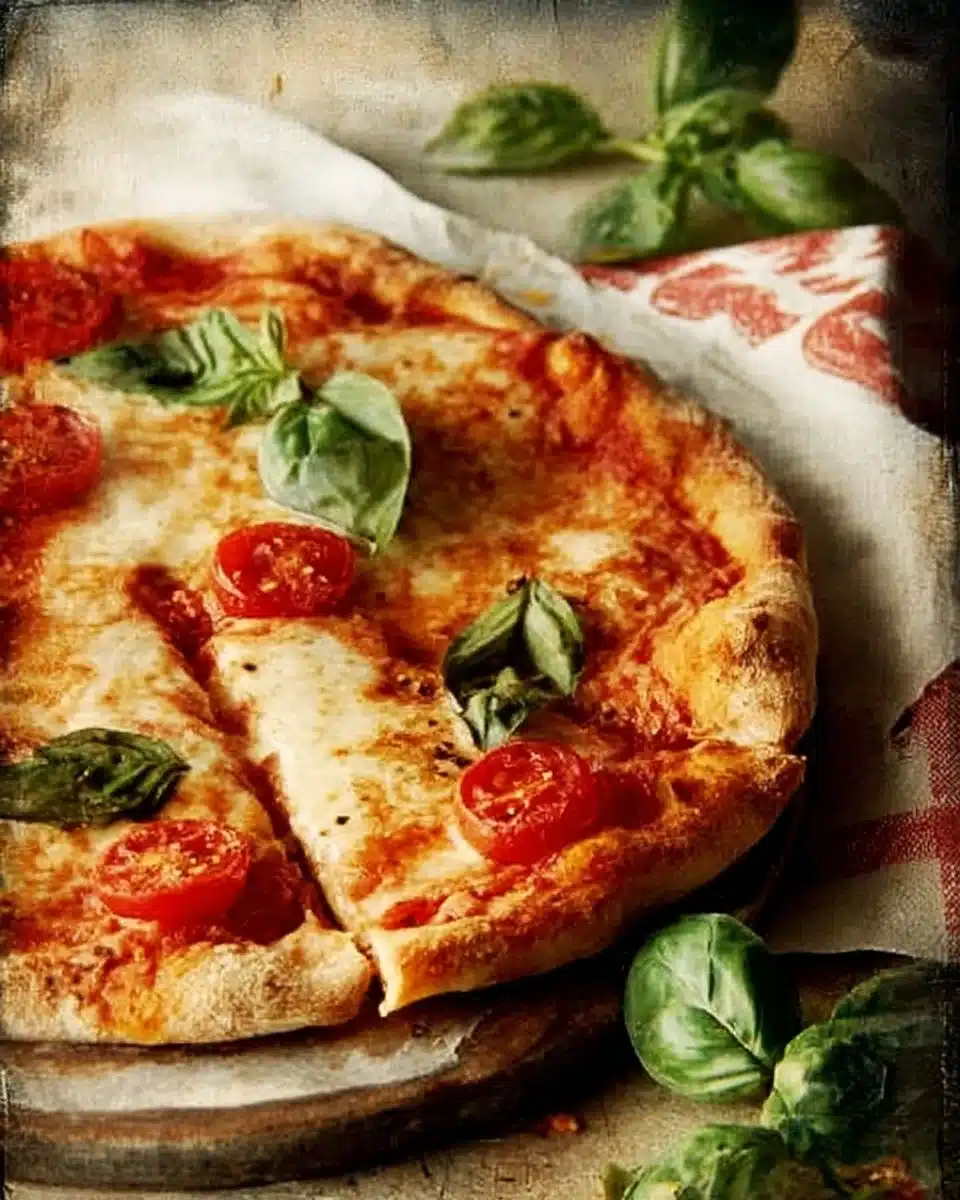
Classic Neapolitan Margherita at Home
Bright tomato, molten mozzarella, and just-picked basil—this Margherita pizza sings when each element is treated simply and well. After testing this dough method 12 times across different flours and ovens, I landed on a balance of chew, blister, and flavor that works in a home oven. This recipe focuses on a slow, cool ferment for taste, a short high-heat bake for char, and a light hand with toppings so the crust stays the star. If you like bold topping ideas, you might also enjoy a richer cheese-and-steak take like this blue cheese steak pizza, but here we keep it classic. Read on for clear weights, timing, and pro tips so your next pie comes out like it was made down the street in Naples.
Why This Recipe Works
- A 12–24 hour cold ferment develops complex flavor without needing commercial yeast quantities.
- High-hydration dough (60%) yields a light, airy crumb and a crisp, blistered exterior.
- Minimal toppings prevent sogginess and let oven spring and char develop.
- A hot oven and preheated steel or stone recreate pizzeria charring in a home oven.
- Simple, peeled tomatoes and fresh mozzarella deliver clean, balanced flavors.
Ingredients Breakdown
- Dough
- 500 g (4 cups) all-purpose flour, 00 if available — gives a softer crumb; bread flour yields more chew.
- 300 g (1 1/4 cups) water, 60% hydration — room temperature. Hydration affects openness; do not add extra water unless you adjust flour.
- 10 g (2 tsp) fine sea salt — balances flavor and strengthens gluten.
- 2 g (1/2 tsp) instant yeast — small amount for a slow ferment; more yeast shortens time but reduces flavor development.
- 15 g (1 tbsp) extra-virgin olive oil — optional; helps browning and handling.
- Substitution warning: Using whole-wheat flour will absorb more water and make a denser crust; increase hydration by 10–20 g water.
- Sauce & Topping
- 400 g (14 oz) canned San Marzano peeled tomatoes, crushed by hand — bright, less acidic than other tomatoes.
- 200 g (7 oz) fresh mozzarella, torn and lightly drained — use low-moisture if your oven is weak; fresh gives creamier melt.
- Fresh basil leaves (about 10–12 leaves) — add after baking for aroma.
- Salt and 1 tsp sugar (optional) to balance sauce acidity.
- Extra-virgin olive oil for finishing.
- Brand note: For salt measurements, use Diamond Crystal kosher salt for the specified amounts; if using Morton, halve the quantity because it is denser.
- Other
- Semolina or cornmeal for dusting — prevents sticking and adds crispness.
Try this buffalo-style pie for a saucier, spicier contrast if you want a topping-forward variation.
Essential Equipment
- Oven capable of reaching 260–290°C (500–550°F) — top-heat helps blister the crust. If your oven tops out lower, use a baking steel and the broiler.
- Baking steel or pizza stone — 12–16 mm steel or a thick stone retains heat for a quick bake.
- Pizza peel — wooden for transferring dough, metal for sliding pizza onto steel.
- Digital scale — accurate weights are critical for dough consistency.
- Instant-read thermometer for checking dough temperature and oven surface if available.
- Bench scraper and bowl — for handling and folding dough.
- Workaround: No peel? Use an inverted rimless baking sheet dusted with semolina.
A cheeseburger-style pizza uses similar tools but different toppings; the equipment overlap makes switching easy.
Step-by-Step Instructions
Makes 4 servings. Prep time: 20 minutes active. Cook time: 8–12 minutes per pizza. Inactive time (cold ferment): 12–24 hours. Total time: about 12–24 hours including fermentation.
Step 1: Mix the Dough
In a large bowl, combine 500 g (4 cups) all-purpose flour and 2 g (1/2 tsp) instant yeast. Add 300 g (1 1/4 cups) water and mix with a spoon until no dry flour remains, 1–2 minutes. Do not overwork; this is a rough mix.
Step 2: Salt and Rest
Add 10 g (2 tsp) fine sea salt and 15 g (1 tbsp) olive oil, then fold into the dough for 30–60 seconds until cohesive. Let rest, covered, 20 minutes (autolyse) to hydrate the flour — you’ll notice the dough relax and become smoother.
Step 3: Stretch-and-Fold (Build Strength)
Perform 3 sets of stretch-and-fold in the bowl every 20 minutes: reach under the dough, stretch it up, and fold over. Each set takes about 1–2 minutes; total active time 5–7 minutes. Dough should feel slightly tacky and develop elasticity.
Step 4: Bulk Ferment (Cold)
Transfer the dough to a lightly oiled container, cover, and refrigerate for 12–24 hours. This long, cold ferment develops flavor; the dough will double in volume slowly. Remove from fridge 1 hour before shaping to take off the chill.
Step 5: Portion and Preheat
Turn dough onto a floured surface, divide into four 250 g (8.8 oz) balls, and shape lightly. Preheat oven with steel or stone on the top rack to 275°C (525°F) for at least 45 minutes. If your oven’s top element is weak, crank to 290°C (550°F) if safe.
Step 6: Shape the Pies
On a well-floured board, press each ball from center to edge to form a 25–28 cm (10–11 inch) disk with a slightly thicker rim. Do not use a rolling pin — you want trapped gas for an airy crust. This step takes 1–2 minutes per pie.
Step 7: Sauce and Top
Spread ~80 g (1/3 cup) crushed San Marzano tomatoes per pie, leaving the rim bare. Add 50 g (1.75 oz) torn fresh mozzarella and a drizzle of olive oil. Keep toppings light — heavy toppings hinder oven spring.
Step 8: Bake
Slide pizza onto the preheated steel and bake 6–10 minutes, rotating once for even char, until the crust is blistered and cheese is melted and slightly browned. If using broiler for extra char, broil 30–60 seconds at the end; watch closely.
Step 9: Finish
Remove pizza, tear fresh basil over the top, and finish with a light drizzle of olive oil and a pinch of sea salt. Let rest 1–2 minutes before slicing; resting keeps the cheese from sliding off.
Step 10: Repeat and Enjoy
Repeat steps 6–9 for remaining pies. Clean your peel and surface between pies to avoid sticking; each bake is quick — expect 8–12 minutes per pizza total.
Expert Tips & Pro Techniques
- Use a digital scale every time: baking by weight gives repeatable results; measuring cups vary widely.
- Common mistake: overloading the pie. Avoid too much sauce or cheese — they trap moisture and prevent a blistered crust.
- If your oven is weak, preheat a cast-iron skillet on the steel and place the pizza on the hot skillet for an extra bottom crisp.
- Make-ahead: Shape balls and refrigerate up to 72 hours; bring to room temp 60–90 minutes before shaping and baking.
- For a professional touch, finish with a few drops of high-quality extra-virgin olive oil and a pinch of flaky sea salt right before serving.
- To test doneness without a probe, look for even charring on the rim and small, blackened bubbles across the surface.
This chicken cordon bleu pizza shows how baking times shift with heavier toppings — use it as a reference if you plan to load your pie.
Storage & Reheating
- Refrigerator: Store whole cooled pizza or slices in an airtight container or wrapped in foil for up to 3 days. Reheat within this time for best quality.
- Freezer: Pizza can be frozen for up to 2 months. Freeze in individual portions on a tray, then wrap tightly in plastic and foil. Thaw in the fridge overnight before reheating.
- Reheating: Best method is in a 190°C (375°F) oven on a wire rack over a sheet pan for 8–10 minutes to re-crisp the crust. Avoid microwaving—microwaves make the crust soggy.
Variations & Substitutions
- Gluten-Free Version: Replace 500 g flour with a 1:1 gluten-free blend (Bob’s Red Mill). Add 1 tsp xanthan gum and reduce water by 15 g. Bake time increases by 2–4 minutes.
- Whole-Wheat: Use 250 g (2 cups) all-purpose + 250 g (2 cups) whole-wheat; increase water to 320 g (1 1/3 cups). Expect a denser chew and richer flavor.
- Vegan: Use dairy-free mozzarella (150–180 g / 5–6 oz per pie) and finish with basil and a drizzle of olive oil. Texture varies by brand—low-moisture vegan cheeses melt better.
- Grilled Pizza: Par-bake on a hot steel for 3 minutes, then finish directly over a hot gas grill for 1–2 minutes per side for smoky char.
- Spicy Tomato: Stir 1 tsp crushed red pepper into the sauce and top with thinly sliced pepperoni. For an alternative spice profile, consider a smoky chorizo variation like this chorizo pizza.
Serving Suggestions & Pairings
- Serve with a simple arugula salad dressed with lemon and olive oil to cut the richness.
- Pair with a crisp Italian lager or a chilled Vermentino for a bright, citrusy match.
- Offer freshly grated Parmigiano-Reggiano and red pepper flakes on the side.
- For family-style comfort, pair with roasted garlic potatoes — see our other oven-friendly sides for timing alignment.
Nutrition Information
Per serving (Serving size: 1 slice; recipe makes 4 servings)
- Calories: 560 kcal
- Total Fat: 22 g
- Saturated Fat: 9 g
- Cholesterol: 55 mg
- Sodium: 820 mg
- Total Carbohydrates: 65 g
- Dietary Fiber: 3 g
- Sugars: 6 g
- Protein: 22 g
Nutrition values are estimates. Actual values may vary based on specific ingredients and preparation methods.
Frequently Asked Questions
Q: Why did my crust turn out dense instead of airy?
A: Dense crust usually means underdeveloped gluten or low hydration. Ensure your stretch-and-fold sets were completed and try 10–20 g more water next time. Also make sure to allow the cold ferment to develop; it helps oven spring.
Q: Can I make this without yeast?
A: You need yeast (or sourdough starter) to get an airy crust. No-yeast flatbreads are possible but fall outside a classic Margherita profile.
Q: Can I double this recipe?
A: Yes. Double all ingredients and divide into eight 250 g balls. Use larger containers and space dough balls so they can expand; handling time increases modestly.
Q: Can I prepare this the night before?
A: Yes. Mix and bulk ferment in the fridge for 12–24 hours. Shape balls the night before or the morning of baking. Bring to room temp 60–90 minutes before shaping.
Q: How long does this keep in the fridge?
A: Baked pizza keeps 2–3 days in the refrigerator in an airtight container. Dough balls can be refrigerated up to 72 hours before baking.
Q: Why is my pizza soggy in the center?
A: Sogginess comes from too much sauce or wet mozzarella. Use light sauce (drain crushed tomatoes slightly) and blot fresh mozzarella with paper towels before topping.
Q: Can I use fresh tomatoes instead of canned?
A: Yes—blanch, peel, seed, and crush them. Canned San Marzano tomatoes are convenient and consistently bright, but fresh can work in season.
Conclusion
This Margherita approach yields a crisp, blistered crust and a clean, bright topping that showcases simple ingredients. For a different but well-tested home method, see the detailed technique at BEST Homemade Margherita Pizza – A Beautiful Plate, and for historical context on the classic recipe visit Pizza Margherita – Wikipedia.
Print
Classic Neapolitan Margherita at Home
- Total Time: 12-24 hours including fermentation
- Yield: 4 servings 1x
- Diet: Vegetarian
Description
A classic Margherita pizza with bright tomato, molten mozzarella, and fresh basil, focusing on a slow ferment for flavor and a high-heat bake for that perfect char.
Ingredients
- 500 g (4 cups) all-purpose flour
- 300 g (1 1/4 cups) water
- 10 g (2 tsp) fine sea salt
- 2 g (1/2 tsp) instant yeast
- 15 g (1 tbsp) extra-virgin olive oil (optional)
- 400 g (14 oz) canned San Marzano peeled tomatoes, crushed by hand
- 200 g (7 oz) fresh mozzarella, torn and lightly drained
- Fresh basil leaves (about 10–12 leaves)
- Salt and 1 tsp sugar (optional) to balance sauce acidity
- Extra-virgin olive oil for finishing
- Semolina or cornmeal for dusting
Instructions
- Mix the Dough: In a large bowl, combine 500 g all-purpose flour and 2 g instant yeast. Add 300 g water and mix with a spoon until no dry flour remains, 1–2 minutes. Do not overwork; this is a rough mix.
- Add 10 g fine sea salt and 15 g olive oil, then fold into the dough for 30–60 seconds until cohesive. Let rest, covered, 20 minutes.
- Perform 3 sets of stretch-and-fold in the bowl every 20 minutes.
- Transfer the dough to a lightly oiled container, cover, and refrigerate for 12–24 hours.
- Turn dough onto a floured surface, divide into four 250 g balls, and shape lightly. Preheat oven with steel or stone on the top rack to 275°C (525°F) for at least 45 minutes.
- On a well-floured board, press each ball from center to edge to form a 25–28 cm disk.
- Spread ~80 g crushed San Marzano tomatoes per pie, leaving the rim bare. Add 50 g torn fresh mozzarella and a drizzle of olive oil.
- Slide pizza onto the preheated steel and bake 6–10 minutes.
- Remove pizza, tear fresh basil over the top, and finish with a drizzle of olive oil and a pinch of sea salt.
- Repeat for remaining pies.
Notes
Clean your peel and surface between pies to avoid sticking. Expect 8–12 minutes total bake time per pizza.
- Prep Time: 20 minutes
- Cook Time: 8-12 minutes per pizza
- Category: Main Course
- Method: Baking
- Cuisine: Italian
Nutrition
- Serving Size: 1 slice
- Calories: 560
- Sugar: 6g
- Sodium: 820mg
- Fat: 22g
- Saturated Fat: 9g
- Unsaturated Fat: 13g
- Trans Fat: 0g
- Carbohydrates: 65g
- Fiber: 3g
- Protein: 22g
- Cholesterol: 55mg