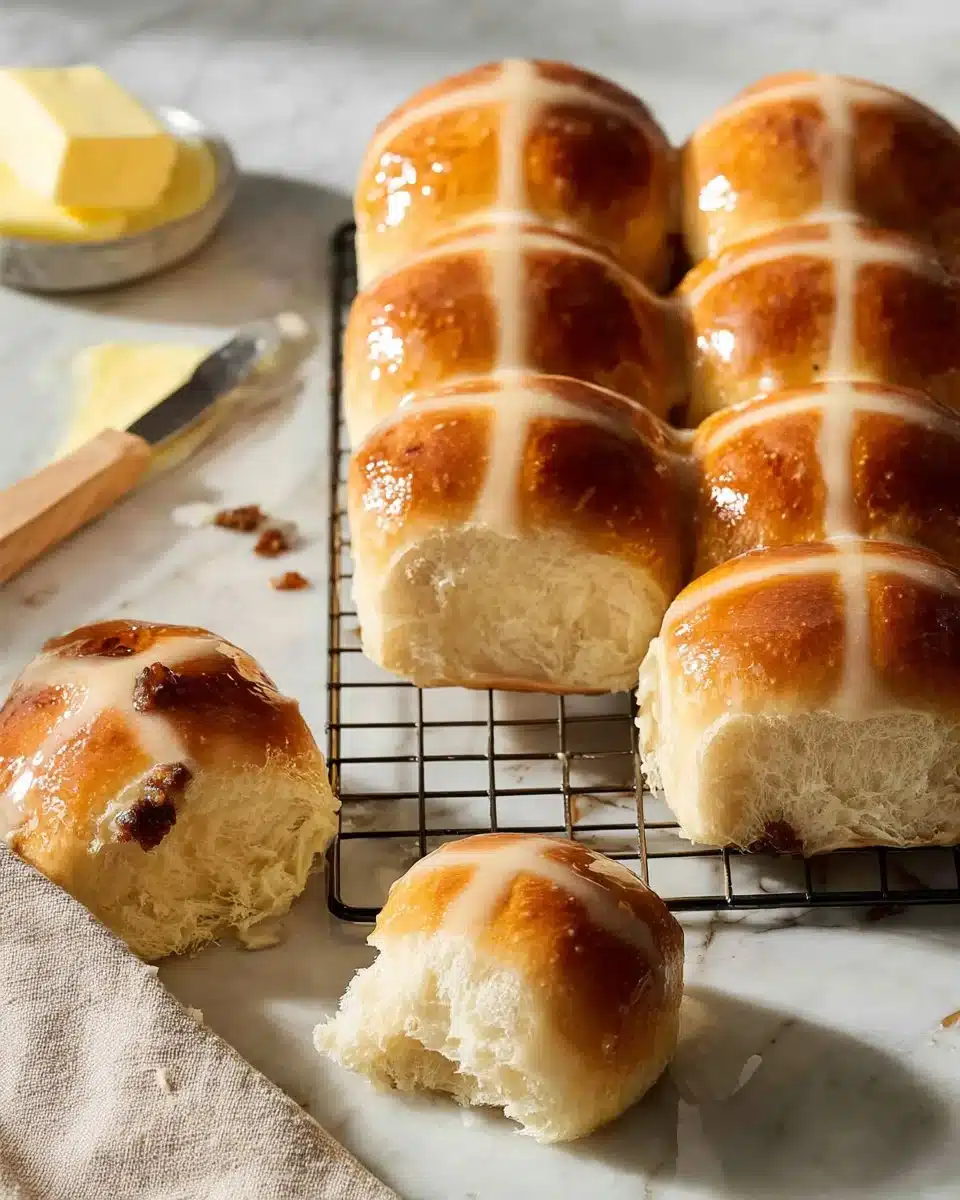
Classic Hot Cross Buns — Soft Spiced Yeast Buns
Warm, fragrant, and lightly spiced, these hot cross buns fill the kitchen with the scent of orange and cinnamon the moment they go into the oven. After testing this recipe eight times with different flours and proofing schedules, I settled on a method that makes a tender crumb and a glossy, set cross every time. This is the version I perfected for busy mornings and make-ahead baking — it holds up well refrigerated or frozen and responds beautifully to a light egg wash and sugar glaze. Read on for clear, metric-and-imperial measurements, exact timings, and troubleshooting tips so your batch comes out bakery-perfect.
Why This Recipe Works
- The dough uses a small amount of butter and an enriched dough technique to produce a soft, tender crumb without being heavy.
- A short autolyse (rest after mixing flour and liquid) helps gluten form gently for a supple texture.
- Toasted mixed spice and orange zest release volatile aromatics that keep flavor bright even after chilling.
- A thin paste for the cross bakes into a visible, set design without weighing the buns down.
- A hot sugar glaze applied right out of the oven gives a shiny finish and keeps the crust slightly chewy.
Ingredients Breakdown
- All-purpose flour 500 g (4 cups): Provides structure. You can use strong bread flour for a slightly chewier bun; the crumb will be denser.
- Instant yeast 7 g (1 packet / 2 1/4 tsp): Reliable rise with minimal fuss. If using active dry yeast, proof in warm milk first.
- Granulated sugar 75 g (1/3 cup): Sweetens and feeds the yeast. Reduce by 15–25 g for less sweet buns; texture will be slightly firmer.
- Salt 9 g (1 1/2 tsp) Diamond Crystal / 1 tsp Morton’s: Balances flavor. If using Morton’s, use slightly less.
- Unsalted butter 60 g (4 tbsp), softened: Adds richness and tenderizes the crumb.
- Whole milk 240 ml (1 cup), warmed to 37–43°C (100–110°F): Hydrates and activates yeast. For dairy-free, use unsweetened almond milk — color and flavor will differ.
- Large eggs 2 (about 100 g / 3.5 oz): Enrich the dough and help with color. For an eggless version, see Variations.
- Mixed fruit (currants or raisins) 150 g (1 cup), soaked 10 minutes in warm water and drained: Adds chew and sweetness. Substitute chopped dried apricots for a fruitier note.
- Orange zest 1 tbsp: Brightens the spice blend.
- Ground mixed spice (or cinnamon + nutmeg) 2 tsp: Warms the dough; toasting whole spices beforehand intensifies flavor.
- For the cross: Plain flour 60 g (1/2 cup) + water to make a pipeable paste.
- Glaze: Apricot jam 60 g (1/4 cup) + 1 tbsp water, warmed and strained; or a simple sugar syrup.
For an ultra-glossy finish, consider a gelatin-based glaze from our guide to gelatin-based glazes — it sets harder and keeps buns shiny longer.
Essential Equipment
- Stand mixer with dough hook (recommended) or a large mixing bowl and a strong arm for hand-kneading.
- Digital scale for accurate flour weight (250 g flour per 2 cups varies).
- 20 x 30 cm (8 x 12 inch) baking tray or a 9 x 13-inch pan; avoid smaller pans to prevent crowding.
- Piping bag or zip-top bag with corner snipped for piping crosses.
- Instant-read thermometer to check milk and dough temperatures.
If you prefer a faster finish or lack an oven, check our notes on air-fryer adaptations for other bake methods.
Makes 12 buns. Prep time 30 minutes; Cook time 18–22 minutes; Inactive time 1 hour 40 minutes (rising); Total time about 2 hours 30 minutes. Serves 12 (1 bun each).
Step 1: Warm the milk and bloom the yeast
Warm 240 ml (1 cup) whole milk to 37–43°C (100–110°F) and place it in the bowl of a stand mixer. Add 7 g (2 1/4 tsp / 1 packet) instant yeast and 1 tbsp of the sugar, stirring to dissolve. Wait 5 minutes until foamy if using active dry yeast; instant yeast can be mixed directly. This takes about 5 minutes.
Step 2: Mix the dough
Add 500 g (4 cups) all-purpose flour, 75 g (1/3 cup) sugar, 9 g (1 1/2 tsp) salt, 2 tsp ground mixed spice, 1 tbsp orange zest, 2 beaten eggs (about 100 g), and 60 g (4 tbsp) softened butter to the milk. Mix on low speed with a dough hook for 4–6 minutes until a soft, slightly tacky dough forms. If mixing by hand, combine and knead for 8–10 minutes. Do not overmix — stop as soon as the dough is smooth and slightly elastic.
Step 3: Add fruit and first rise
Fold in 150 g (1 cup) drained currants or raisins by hand for 30–60 seconds. Form the dough into a ball, place in a lightly greased bowl, cover with cling film or a damp towel, and let rise in a warm spot until doubled, about 60–75 minutes depending on room temperature. A properly risen dough will hold an indentation when gently pressed.
Step 4: Shape the buns
Turn the dough out onto a lightly floured surface and divide into 12 equal pieces (about 65–70 g / 2 1/4–2 1/2 oz each). Shape each into a tight ball and place them on a lined 20 x 30 cm (8 x 12 inch) tray, spaced about 2 cm (3/4 inch) apart for a soft-sided finish. Cover and proof for 30–40 minutes until puffy and nearly doubled. This proof should take 30–40 minutes.
Step 5: Pipe the crosses and bake
Make the cross paste: mix 60 g (1/2 cup) plain flour with enough water to make a thick, pipeable paste (about 50–60 ml / 3–4 tbsp). Transfer to a piping bag and pipe a cross on each bun. Preheat the oven to 200°C (400°F). Bake at 200°C (400°F) for 18–22 minutes until the tops are golden brown and an instant-read thermometer reads about 88°C (190°F) in the center. If tops brown too quickly, tent loosely with foil after 12 minutes.
Step 6: Glaze and cool
Warm 60 g (1/4 cup) apricot jam with 1 tbsp water until syrupy and brush over the buns immediately after they come from the oven for shine and a slight sweetness. Cool on a wire rack for at least 20 minutes before serving.
Expert Tips & Pro Techniques
- Use a scale: weighing dough pieces to 65–70 g ensures even baking and uniform appearance.
- Common mistake: overproofing makes buns collapse. If the dough collapses when poked, shape and bake immediately to salvage texture.
- Make-ahead: after shaping, cover and refrigerate the tray overnight (8–12 hours). Bring to room temperature 30–45 minutes before baking and increase bake time by 2–4 minutes.
- Professional trick at home: autolyse — mix flour and milk first and rest 15 minutes before adding yeast, butter, and eggs. This improves dough extensibility without extra kneading.
- To keep buns soft, brush with warm syrup each time you reheat. Avoid microwaving; it softens the crust and makes them chewy.
- For even fruit distribution, toss dried fruit in 1 tsp flour before adding to the dough.
For simple make-ahead ideas that pair well with batch baking, see our collection of simple make-ahead ideas and one-pot recipes.
Storage & Reheating
- Refrigerator: Store cooled buns in an airtight container or resealable bag for up to 4 days. Brush with a little warm syrup before serving to refresh.
- Freezer: Freeze individual cooled buns wrapped tightly in plastic and placed in a freezer bag for up to 3 months. Thaw at room temperature or overnight in the fridge.
- Reheating: Reheat in a 175°C (350°F) oven for 8–10 minutes from thawed, or 12–15 minutes from frozen. Avoid microwaving for more than 15–20 seconds — it ruins the crust.
Variations & Substitutions
- Eggless Version: Replace 2 eggs with 120 g (1/2 cup) Greek yogurt or 100 g (1/3 cup) applesauce. Texture will be slightly denser and baking time may increase by 3–5 minutes.
- Gluten-Free: Use a 1:1 gluten-free flour blend (500 g) plus 1 tsp xanthan gum. Dough will be stickier; chill for 30 minutes before shaping. Bake 3–5 minutes longer.
- Fruit-Free: Omit currants and add 1 tsp extra orange zest and 50 g (1/2 cup) chopped toasted almonds for crunch; everything else stays the same.
- Spiced Chocolate: Replace mixed spice with 2 tsp cinnamon and fold in 75 g (1/2 cup) chocolate chips; reduce sugar by 15 g.
- Reduced-Sugar: Cut sugar to 50 g (1/4 cup). Yeast activity will be slightly slower; allow an extra 10–20 minutes for the first rise.
Serving Suggestions & Pairings
- Serve warm split and buttered with a cup of strong tea or coffee. For a lighter breakfast pairing, try these lighter breakfast pairings.
- Make a dessert: split warm buns, spoon in a little mascarpone and honey, and top with toasted almonds.
- Brunch board: pair with fruit preserves, soft cheeses, and boiled eggs for contrast.
- Beverage pairing: a cardamom latte or a citrusy Earl Grey complements the orange zest.
Nutrition Information
Per serving (1 bun). Serves 12.
- Calories: 310 kcal
- Total Fat: 7 g
- Saturated Fat: 4 g
- Cholesterol: 60 mg
- Sodium: 220 mg
- Total Carbohydrates: 53 g
- Dietary Fiber: 2 g
- Sugars: 18 g
- Protein: 6 g
Nutrition values are estimates. Actual values may vary based on specific ingredients and preparation methods.
Frequently Asked Questions
Q: Why did my buns turn out dense or doughy in the center?
A: Most likely they were underbaked or underproofed. Make sure the dough doubled before shaping and that the internal temperature reaches about 88°C (190°F). If the center is still doughy, bake 3–5 minutes longer.
Q: Can I make this without eggs?
A: Yes. Replace the two eggs with 120 g (1/2 cup) Greek yogurt or 100 g (1/3 cup) unsweetened applesauce. Expect a slightly denser crumb and add 2–3 extra minutes of baking time.
Q: Can I double this recipe?
A: Yes. Double every ingredient and proof the dough in two large bowls or one very large container. Baking time per batch is the same, but bake on two trays to avoid crowding. Do not double in a single small pan.
Q: Can I prepare this the night before?
A: Absolutely. After shaping, cover and refrigerate overnight (8–12 hours). Bring to room temperature 30–45 minutes before baking and add 2–4 minutes to the bake time.
Q: How long do hot cross buns keep in the fridge?
A: Stored in an airtight container, they keep 3–4 days in the refrigerator. For longer storage, freeze for up to 3 months.
Q: Why did the crosses spread or disappear in the oven?
A: The paste may have been too thin or the buns overproofed. Make a thicker paste and pipe just before baking. If overproofed, the dough may flatten and the paste will sink.
Q: Can I use fresh yeast instead of instant?
A: Yes — use 15 g fresh yeast. Crumble into the warm milk with a pinch of sugar and wait 5–10 minutes until foamy before mixing.
Conclusion
If you want to compare techniques or try another tested approach, the RecipeTin Eats version offers clear step photos and timing adjustments in its Hot Cross Buns Recipe – RecipeTin Eats. For a guide focused on traditional shaping and historical notes, see Culinary Ginger’s tutorial on How to Make Traditional Hot Cross Buns – Culinary Ginger.
Print
Classic Hot Cross Buns
- Total Time: 150 minutes
- Yield: 12 servings 1x
- Diet: Vegetarian
Description
Warm, fragrant, and lightly spiced, these hot cross buns fill the kitchen with the scent of orange and cinnamon. They are soft, tender, and perfect for busy mornings.
Ingredients
- 500 g (4 cups) all-purpose flour
- 7 g (1 packet / 2 1/4 tsp) instant yeast
- 75 g (1/3 cup) granulated sugar
- 9 g (1 1/2 tsp) salt
- 60 g (4 tbsp) unsalted butter, softened
- 240 ml (1 cup) whole milk, warmed
- 2 large eggs (about 100 g)
- 150 g (1 cup) mixed fruit (currants or raisins), soaked and drained
- 1 tbsp orange zest
- 2 tsp ground mixed spice (or cinnamon + nutmeg)
- 60 g (1/2 cup) plain flour for cross + water to make a pipeable paste
- 60 g (1/4 cup) apricot jam + 1 tbsp water for glaze
Instructions
- Warm the milk and bloom the yeast: Warm 240 ml (1 cup) whole milk to 37–43°C (100–110°F) and add 7 g (2 1/4 tsp) instant yeast and 1 tbsp of the sugar. Wait 5 minutes until foamy.
- Mix the dough: Add 500 g (4 cups) all-purpose flour, 75 g (1/3 cup) sugar, 9 g (1 1/2 tsp) salt, 2 tsp ground mixed spice, 1 tbsp orange zest, 2 beaten eggs, and 60 g (4 tbsp) softened butter to the milk. Mix on low speed for 4–6 minutes until a soft dough forms.
- Fold in the fruit: Add 150 g (1 cup) drained currants or raisins by hand. Let the dough rise in a warm spot until doubled, about 60–75 minutes.
- Turn the dough out and shape into 12 pieces. Place on a lined tray, cover, and proof for 30–40 minutes.
- Preheat the oven to 200°C (400°F). Make cross paste with 60 g (1/2 cup) plain flour and enough water to make a pipeable paste. Pipe crosses on each bun.
- Bake for 18–22 minutes until golden brown and an internal temperature of 88°C (190°F) is reached.
- Brush warm glaze over the buns immediately after baking. Cool on a wire rack before serving.
Notes
Use weighing for accurate dough pieces. For make-ahead options, refrigerate the shaped dough overnight and let sit at room temperature before baking.
- Prep Time: 30 minutes
- Cook Time: 22 minutes
- Category: Baked Goods
- Method: Baking
- Cuisine: British
Nutrition
- Serving Size: 1 bun
- Calories: 310
- Sugar: 18g
- Sodium: 220mg
- Fat: 7g
- Saturated Fat: 4g
- Unsaturated Fat: 3g
- Trans Fat: 0g
- Carbohydrates: 53g
- Fiber: 2g
- Protein: 6g
- Cholesterol: 60mg