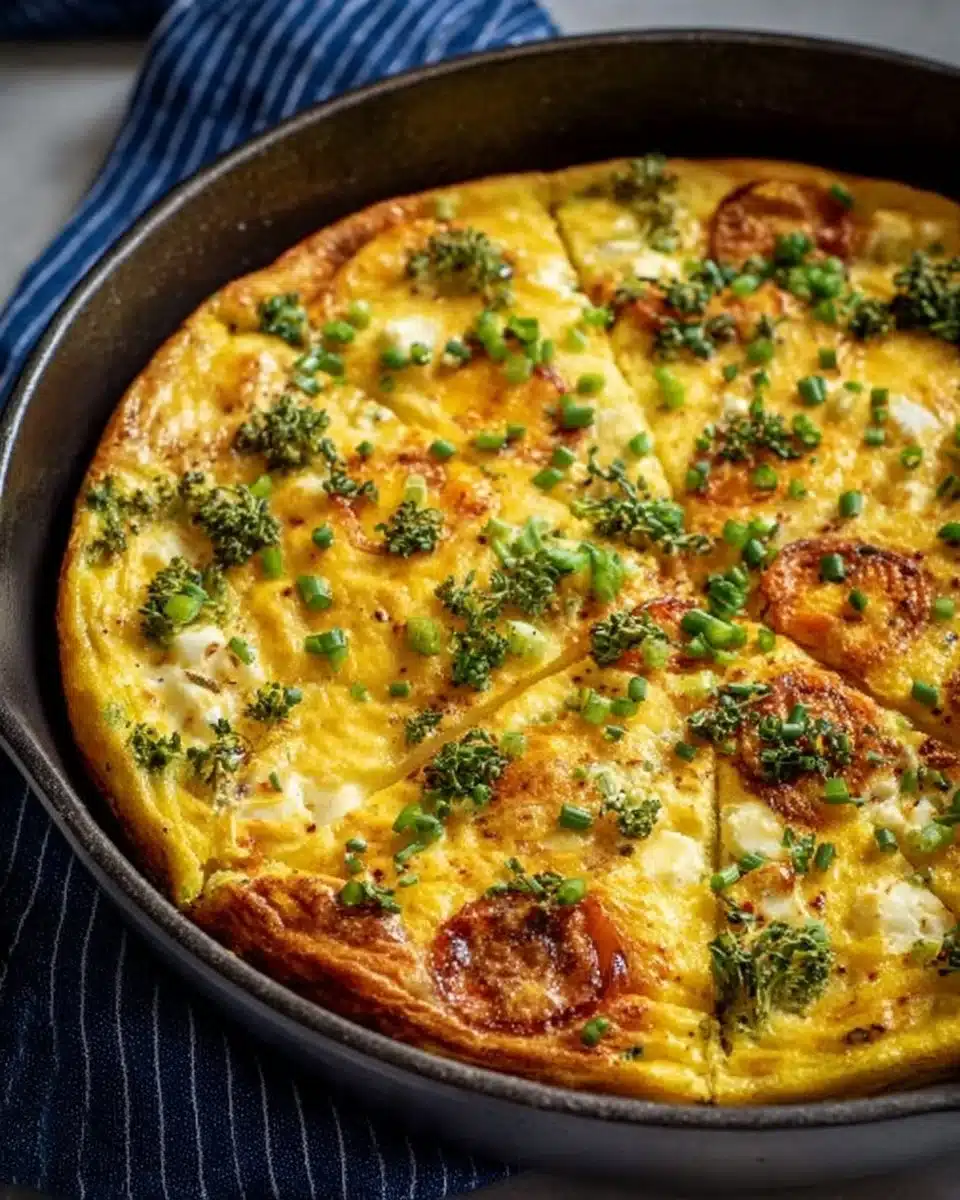
Classic Frittata Recipe — Fast, One-Skillet Dinner
Golden edges, soft center, and a crispy bottom — a frittata is bright, flexible, and forgiving. This classic frittata recipe delivers a reliable stovetop-to-oven method that works every time, whether you’re using fresh herbs or last-night vegetables. After testing this version 8 times across different skillets and ovens, I settled on the technique below for the most consistent lift and texture. I developed it while cooking breakfast service at a neighborhood bistro; the goal was speed without sacrificing creaminess. Try it tonight and you’ll see why one pan can make a weeknight feel special. For a similar potato-forward take, try this potato and cherry tomato frittata in your rotation.
Why This Recipe Works
- Hot skillet, gentle oven finish: searing the base creates a flavorful crust while the oven cooks the center evenly.
- Egg-to-dairy ratio tuned for creaminess: enough milk for silk, not so much that the eggs turn custardy and weep.
- Salt timing: salting eggs early seasons evenly; salting vegetables after they sweat prevents a watery frittata.
- Room-temperature eggs: they emulsify better with the dairy for a uniform texture.
- Minimal stirring: gentle folding keeps air pockets intact so the result is light, not rubbery.
Ingredients Breakdown
- Eggs (6 large — about 330 g): The structure and primary protein. Use room-temperature eggs for better volume and texture.
- Whole milk (120 ml / 1/2 cup): Adds silkiness. You can use single cream for richer texture or milk for a lighter result.
- Parmesan cheese, finely grated (40 g / 1/3 cup): Adds salt and umami. Pecorino or aged cheddar will change the flavor profile.
- Olive oil (30 ml / 2 tbsp) or unsalted butter (30 g / 2 tbsp): For searing. Butter browns faster; use clarified butter if you want higher heat.
- Onion or shallot (1 small, 100 g / 1 cup sliced): Provides sweetness and depth after sweating.
- Vegetables (200–250 g total): Spinach, bell pepper, mushrooms, or zucchini work well. If using watery veg like zucchini, salt and drain to avoid a soggy frittata.
- Fresh herbs (15 g / 1/4 cup loosely packed): Parsley, chives, or dill brighten the finished dish.
- Kosher salt and black pepper: Season to taste. Use Diamond Crystal kosher salt; if you use Morton’s, halve the quantity as it is denser.
- Optional mix-ins: cooked potatoes, bacon, or smoked salmon. For vegetarian swaps, increase cheese or add roasted red peppers.
Substitutions with impact warnings:
- Dairy swap: Use Greek yogurt (120 g / 1/2 cup) instead of milk — expect slightly tangier, denser texture.
- Egg substitute: A vegan frittata requires chickpea flour or silken tofu; technique changes substantially (see Variations).
- Gluten-free: Naturally gluten-free. No flour used.
Essential Equipment
- 10-inch (25 cm) ovenproof skillet with tight-fitting handle (cast-iron preferred): prevents heat shock when moving from stovetop to oven.
- Mixing bowl and whisk: for even egg mixture.
- Rubber spatula: for folding and transferring.
- Kitchen thermometer (optional): checks doneness — target 70°C (160°F) center.
- Oven mitts and cooling rack.
If you don’t have a 10-inch skillet, use a 9-inch (23 cm) deep-dish pie pan as a workaround and adjust timing slightly.
Step-by-Step Instructions
Servings: 4 slices. Serving size: 1 slice. Prep time: 10 minutes. Cook time: 20 minutes. Inactive time: None. Total time: 30 minutes.
Step 1: Preheat and prep
Preheat oven to 175°C (350°F). Whisk together 6 large eggs (approximately 330 g) with 120 ml (1/2 cup) whole milk, 40 g (1/3 cup) grated Parmesan, 1/2 tsp kosher salt, and 1/4 tsp black pepper until just blended, about 30 seconds. Set the egg mix aside for 5 minutes at room temperature so the flavors meld.
Step 2: Cook the vegetables and aromatics
Heat 30 ml (2 tbsp) olive oil in a 10-inch (25 cm) ovenproof skillet over medium heat. Add 1 small sliced onion (100 g) and sauté until translucent and fragrant, about 5–6 minutes, stirring every 30 seconds. Add 200–250 g of vegetables (for example, 100 g mushrooms and 100 g baby spinach) and cook until moisture evaporates, about 3–4 minutes.
Step 3: Combine mix-ins and season
If using cooked meats or potatoes, add 100 g now and toss for 1 minute to heat through. Taste and adjust seasoning: remember vegetables cooked first need less salt than raw ones. Scatter half of the herbs over the vegetable base.
Step 4: Add eggs and set on stovetop
Reduce heat to low and pour the egg mixture evenly into the skillet. Tilt the pan to distribute. Cook undisturbed for 2–3 minutes, lifting the edges with a spatula to let uncooked egg flow underneath. You want the edges set but the center slightly loose.
Step 5: Finish in the oven
Transfer skillet to the preheated oven and bake for 10–12 minutes until the center is just set and a thermometer reads 70°C (160°F). For a browned top, put under a broiler on high for 1–2 minutes, watching closely. Remove and rest 3 minutes before slicing. Do not overbake — the frittata will firm up as it cools.
Expert Tips & Pro Techniques
- For even cooking, bring eggs to room temperature before mixing. Cold eggs tighten and yield uneven texture.
- Common mistake: overcrowding the skillet with wet vegetables. Avoid by sweating and draining excess moisture first.
- Make-ahead: Cook base vegetables and store separately for up to 3 days in the fridge; whisk eggs just before baking and assemble when ready.
- Home pro trick: finish under the broiler for 30–90 seconds to get a glossy, golden top like a restaurant frittata.
- If your skillet isn’t ovenproof, slide ingredients into a greased 9-inch (23 cm) pie dish and bake 12–15 minutes.
- For a fluffier frittata, whisk eggs briskly for 60 seconds to incorporate more air; don’t overmix once dairy is added.
- To avoid a soggy center, let the skillet rest on the stovetop for 1–2 minutes before transferring to the oven so the bottom firms.
Storage & Reheating
- Refrigerator: Cool completely, then store in an airtight container for up to 4 days. Reheat individual slices in a preheated oven at 175°C (350°F) for 8–10 minutes.
- Freezer: Frittatas freeze well. Wrap cooled slices tightly in plastic, then foil, and freeze up to 2 months. Thaw overnight in the fridge.
- Reheating: Best in the oven or a toaster oven to preserve texture. Reheat at 175°C (350°F) for 10–12 minutes. Avoid microwaving when possible as it can make the texture rubbery.
Variations & Substitutions
- Mediterranean: Keep the method the same. Use 150 g chopped tomatoes (drained), 80 g crumbled feta, and 30 g chopped kalamata olives. No timing changes.
- Mushroom & Thyme (vegetarian): Increase mushrooms to 250 g and use 15 g fresh thyme. Sauté mushrooms 6–8 minutes to brown; bake time unchanged.
- Spinach & Goat Cheese (lighter): Use 150 g baby spinach (cooked down) and 60 g goat cheese crumbled on top. If using frozen spinach, thaw and squeeze dry first.
- Make it dairy-free: Replace milk with 120 ml unsweetened soy milk and omit cheese. Expect slightly less richness; bake time unchanged.
- Vegan chickpea frittata (for those asking how to make a frittata without eggs): Use 200 g chickpea flour, 480 ml water, 2 tbsp nutritional yeast, 1 tsp kala namak (gives an eggy flavor), and 1 tsp baking powder. Whisk batter, cook base as usual, pour into skillet, and bake 18–22 minutes until set. Note: this substantially changes texture and flavor.
Mentioning "frittata variations" helps you customize seasonally without changing the core technique.
Serving Suggestions & Pairings
- Serve with a crisp green salad and a simple lemon vinaigrette for brightness.
- Pair with roasted potatoes or a grain salad for a heartier meal.
- Garnish with chopped chives or microgreens and a drizzle of good olive oil.
- Beverage pairing: A light-bodied white wine, such as Pinot Grigio, or a citrusy herbal tea at brunch.
For a quick sheet-pan approach, see our sheet-pan frittata for large groups.
Nutrition Information (per serving)
Serving size: 1 slice. Recipe yields 4 servings.
- Calories: 320 kcal
- Total Fat: 22 g
- Saturated Fat: 8 g
- Cholesterol: 380 mg
- Sodium: 520 mg
- Total Carbohydrates: 6 g
- Dietary Fiber: 1 g
- Sugars: 3 g
- Protein: 22 g
Nutrition values are estimates. Actual values may vary based on specific ingredients and preparation methods.
Frequently Asked Questions
Q: Why did my frittata turn out dry?
A: Overbaking is the main cause. Remove the pan when the center still jiggles slightly; it will finish setting as it cools. Check for an internal temperature of about 70°C (160°F).
Q: Can I make this without eggs?
A: Yes, try a chickpea-flour batter (see the vegan variation). Expect a denser, bread-like texture rather than classic eggs.
Q: Can I double this recipe?
A: Yes. For two skillets, double all ingredients and cook in two 10-inch pans. If using one larger pan, increase bake time by 3–6 minutes and check doneness with a thermometer.
Q: Can I prepare this the night before?
A: You can cook the vegetable base the night before and keep it refrigerated. Whisk eggs fresh just before baking for best lift. Fully cooked frittata can also be reheated the next day.
Q: How long does this keep in the fridge?
A: Stored in an airtight container, slices keep up to 4 days in the refrigerator.
Q: My frittata is too runny in the center — what went wrong?
A: Likely underbaked or too much liquid (too much milk or watery vegetables). Bake until center reaches 70°C (160°F.
Q: What’s the best skillet to use?
A: Cast-iron or heavy stainless-steel ovenproof skillets provide even browning. If your skillet isn’t ovenproof, transfer to a greased 9-inch (23 cm) pie dish before baking.
For seasoning inspiration, I often reference small seasoning techniques such as the blue salt trick when balancing finish salt.
If you want to explore texture adjustments and binding methods for make-ahead breakfasts, read about the gelatin trick and how it affects set.
Conclusion
A good frittata is fast, flexible, and forgiving. Use hot-to-oven technique, properly sweat your vegetables, and don’t overbake. If you want an alternate method or more ideas, check the step-by-step guide at Love and Lemons’ frittata tutorial and find extra recipe variations at Sally’s Baking Addiction frittata recipes & variations.
Author: Jamie Calder — Culinary school graduate, 15 years professional chef.
Date Published: 2026-03-09

Classic Frittata
- Total Time: 30 minutes
- Yield: 4 servings 1x
- Diet: Vegetarian
Description
A classic frittata with golden edges, soft center, and a crispy bottom, perfect for a quick and impressive meal.
Ingredients
- 6 large eggs (about 330 g)
- 120 ml (1/2 cup) whole milk
- 40 g (1/3 cup) finely grated Parmesan cheese
- 30 ml (2 tbsp) olive oil or 30 g (2 tbsp) unsalted butter
- 1 small onion (100 g, sliced)
- 200–250 g mixed vegetables (spinach, bell pepper, mushrooms, or zucchini)
- 15 g (1/4 cup) fresh herbs (parsley, chives, or dill)
- Kosher salt and black pepper to taste
- Optional: 100 g cooked potatoes, bacon, or smoked salmon
Instructions
- Preheat oven to 175°C (350°F). Whisk together eggs, milk, Parmesan, salt, and pepper, then let sit for 5 minutes.
- Heat olive oil in a 10-inch ovenproof skillet over medium heat. Sauté onion until translucent, then add vegetables and cook until moisture evaporates.
- Add cooked meats or potatoes if using, and season. Scatter half of the herbs over the vegetable mixture.
- Pour the egg mixture into the skillet and cook undisturbed for 2–3 minutes until edges set.
- Transfer skillet to the oven and bake for 10–12 minutes until the center is just set. Rest for 3 minutes before slicing.
Notes
For best results, use room temperature eggs and avoid overcrowding the skillet with wet vegetables. Can be made ahead by prepping vegetables and storing them separately.
- Prep Time: 10 minutes
- Cook Time: 20 minutes
- Category: Breakfast
- Method: Baking
- Cuisine: Italian
Nutrition
- Serving Size: 1 slice
- Calories: 320
- Sugar: 3g
- Sodium: 520mg
- Fat: 22g
- Saturated Fat: 8g
- Unsaturated Fat: 12g
- Trans Fat: 0g
- Carbohydrates: 6g
- Fiber: 1g
- Protein: 22g
- Cholesterol: 380mg