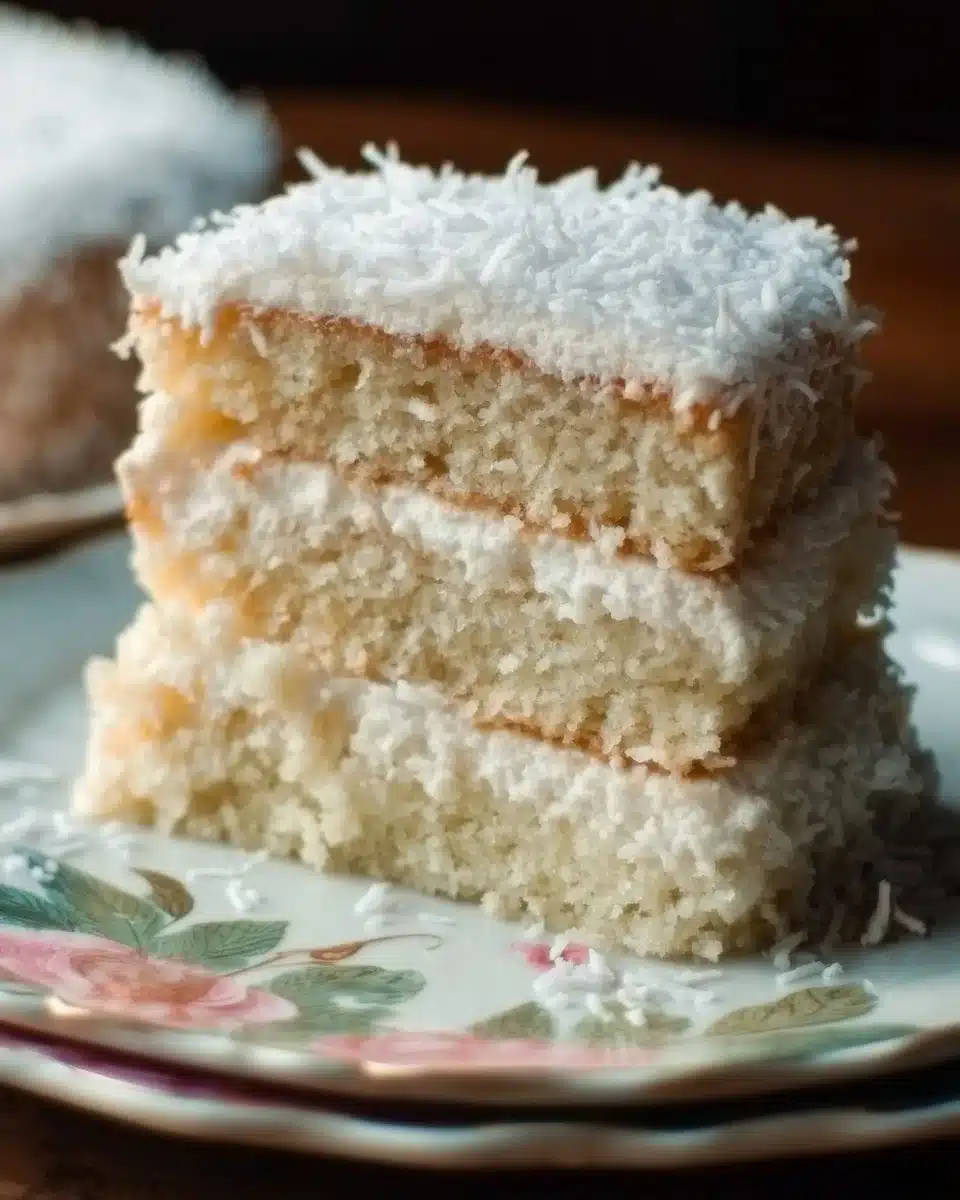
Classic Coconut Cake Recipe — Light, Moist
The first bite is a whisper of toasted coconut and vanilla, so tender it melts on the tongue — this coconut cake recipe delivers that moment every time. I perfected this version after testing it eight times with different fats and flour blends to balance moisture and structure. The crumb stays soft because of a little buttermilk and sour cream, and the coconut buttercream is tempered with cream cheese so it isn’t cloying. If you like a lighter coconut sponge, try our Coconut Cloud Cake for an airy alternative. Read on for precise steps, metric weights, troubleshooting tips, and confident make-ahead plans so you can bake this for a celebration or a quiet weekend.
Why This Recipe Works
- Buttermilk and sour cream add tang and keep the crumb moist without a gummy texture.
- A small portion of melted butter adds richness while cake flour keeps the cake tender.
- Toasted coconut (not raw) gives aromatic depth and avoids a soggy topping.
- Beating the eggs and sugar until slightly thickened traps air for lift without a dense crumb.
- Cooling and resting the layers before icing prevents the buttercream from sliding.
Ingredients Breakdown
- Cake flour — 360 g (3 cups) cake flour: cake flour gives a fine, tender crumb. You can substitute 360 g (3 cups) all-purpose flour minus 3 tbsp for slightly firmer texture.
- Baking powder & baking soda — 10 g (2 tsp) baking powder and 3 g (½ tsp) baking soda: leaveners together give lift and neutralize acidity.
- Salt — 6 g (1 tsp) fine salt: balances sweetness. If using Morton’s kosher salt, reduce to ¾ tsp.
- Unsalted butter — 170 g (¾ cup / 6 oz) unsalted butter, softened: adds flavor and moisture; do not use melted butter in the initial creaming step.
- Granulated sugar — 400 g (2 cups) granulated sugar: for structure and tenderness.
- Eggs — 4 large eggs, room temperature (approx. 200 g total): eggs provide structure and moisture. For egg-free option, see Variations.
- Vanilla — 10 ml (2 tsp) pure vanilla extract: key for flavor lift.
- Buttermilk — 240 ml (1 cup) buttermilk, room temperature: acidity tenderizes gluten and reacts with baking soda.
- Sour cream — 120 g (½ cup) full-fat sour cream: adds richness and keeps crumb soft.
- Toasted sweetened shredded coconut — 200 g (2 cups) lightly toasted: fold into batter and reserve some for topping.
- For the frosting: unsalted butter 226 g (1 cup / 8 oz), cream cheese 225 g (8 oz), powdered sugar 480 g (4 cups), heavy cream 30–60 ml (2–4 tbsp), vanilla 5 ml (1 tsp), pinch of salt.
Substitutions and impact warnings:
- Gluten-free: use a 1:1 gluten-free flour blend and add ½ tsp xanthan gum; texture will be slightly crumblier.
- Dairy-free: replace butter with vegan butter and use coconut milk yogurt for sour cream — the coconut flavor will intensify.
- Brand note: Use a reliable cake flour or King Arthur AP adjusted as above for consistent results.
Essential Equipment
- Two 9-inch (23 cm) round cake pans, 2-inch (5 cm) tall — the batter volume fits best in 9-inch pans.
- Stand mixer with paddle attachment or a large bowl and hand mixer — whisk works but expect a firmer arm workout.
- Kitchen scale — for consistent results, especially flour and sugar.
- Instant-read thermometer — to check doneness if using dense fillings.
- Cooling racks and a turntable for icing (optional) — a turntable helps with smooth frosting, but a flat plate and offset spatula work fine.
- Parchment paper and offsets/piping bag for neat assembly.
If you don’t have 9-inch pans, use two 8-inch pans but reduce batter evenly and bake a few minutes longer; the layers will be thicker.
Step-by-Step Instructions
Prep Time: 25 minutes | Cook Time: 24–28 minutes per layer | Inactive Time: 30 minutes cooling | Total Time: 1 hour 45 minutes | Servings: 10–12 slices
Step 1: Toast the Coconut and Preheat
Preheat oven to 175°C (350°F). Spread 200 g (2 cups) sweetened shredded coconut on a baking sheet and toast for 5–7 minutes, stirring once, until golden and fragrant. Cool completely — toasted coconut deepens the flavor and avoids a soggy topping.
Step 2: Prepare the Pans and Dry Ingredients
Line the bottoms of two 9-inch (23 cm) pans with parchment and grease the sides. Whisk together 360 g (3 cups) cake flour, 10 g (2 tsp) baking powder, 3 g (½ tsp) baking soda, and 6 g (1 tsp) salt in a bowl for 30 seconds to aerate. This ensures even rise.
Step 3: Cream Butter and Sugar, Add Eggs
In a mixer, beat 170 g (¾ cup) softened unsalted butter with 400 g (2 cups) sugar on medium speed for 3–4 minutes until pale and slightly thickened. Beat in 4 large eggs, one at a time, scraping the bowl after each, about 20 seconds per egg. Do not overbeat once eggs are added — stop as soon as combined.
Step 4: Alternate Dry and Wet
With mixer on low, add flour mixture in three parts alternately with 240 ml (1 cup) buttermilk and 120 g (½ cup) sour cream, starting and ending with flour. Mix just until no dry streaks remain, about 20–30 seconds per addition. Stop mixing immediately to avoid a tough cake.
Step 5: Fold in Coconut and Bake
Fold in 150 g (1½ cups) of the toasted coconut by hand. Divide batter evenly between pans (about 700–750 g each). Bake at 175°C (350°F) for 24–28 minutes, rotating pans halfway. Cakes are done when tops are golden and a toothpick comes out with a few moist crumbs. Cool in pans 10 minutes, then turn out onto racks to cool completely.
Step 6: Make the Coconut Buttercream
Beat 226 g (1 cup) unsalted butter and 225 g (8 oz) cream cheese until smooth, 2–3 minutes. Gradually add 480 g (4 cups) powdered sugar on low, then 30–60 ml (2–4 tbsp) heavy cream, 5 ml (1 tsp) vanilla, and a pinch of salt. Beat 2 minutes until light and spreadable. Fold in remaining 50 g (½ cup) toasted coconut if desired.
Step 7: Assemble and Chill
Level the cakes if needed. Place the first layer on a plate, spread 1 cup (240 g) frosting evenly, add second layer, crumb coat with a thin frosting layer, then chill 15–20 minutes. Finish with final coat and decorate with reserved toasted coconut. Chill 20–30 minutes to set before slicing.
Expert Tips & Pro Techniques
- Underbake slightly: Pull the layers at the lower end of doneness (toothpick with moist crumbs) to keep them tender after chilling.
- Common mistake: Overmixing the batter causes a tight crumb. Mix only until the flour disappears.
- Even layers: Weigh the batter for perfect symmetry — about 700–750 g per 9-inch pan.
- Make-ahead: Bake the layers up to 2 days ahead, wrap tightly in plastic, and refrigerate. Bring to room temperature before frosting.
- Professional technique at home: Use a simple syrup brushed on layers (2 tbsp sugar dissolved in 60 ml water) to add moisture and increase shelf life without soggying the crumb.
- Frosting texture: If the buttercream is too soft, chill for 15 minutes and rewhip briefly; avoid adding excess powdered sugar which makes it grainy.
- Serving tip: Toast coconut just before serving for maximum crunch and aroma.
I refined my mixing and folding techniques while adapting methods from other dense cakes, which helped develop the balance of moisture here.
Storage & Reheating
- Refrigerator: Store the frosted cake in an airtight cake box or a cake dome for up to 4 days. The frosting keeps the cake moist.
- Freezer: The unfrosted layers freeze well for up to 3 months. Wrap each layer in plastic wrap and foil. Thaw overnight in the fridge, then bring to room temperature before icing.
- Reheating: For a slightly warm slice, place on a baking sheet and reheat in a 160°C (325°F) oven for 6–8 minutes. Avoid microwaving — it makes the cake gummy.
Variations & Substitutions
- Gluten-Free Version: Replace with 360 g (3 cups) 1:1 gluten-free flour blend and add ½ tsp xanthan gum. Baking time may increase by 3–5 minutes.
- Dairy-Free Version: Use 170 g (¾ cup) vegan butter and 240 ml (1 cup) unsweetened coconut yogurt in place of buttermilk/sour cream; flavor will skew more coconut-forward.
- Lighter Coconut Layer Cake: Swap 120 g (1 cup) of cake flour for 120 g (1 cup) sifted pastry flour and fold in whipped egg whites for extra lift. See a lighter approach in our Coconut Cloud Cake.
- Rum-Soaked Layers: Brush each layer with 2 tbsp rum mixed with 2 tbsp simple syrup for an adult version; keep the rest unchanged.
- Eggless Option: Substitute each egg with 60 g (¼ cup) applesauce plus 1 tsp baking powder extra; texture will be softer and slightly more moist.
Serving Suggestions & Pairings
- Coffee or tea: Strong coffee or a jasmine tea cuts the sweetness and suits brunch.
- Fruit garnish: Fresh pineapple or mango slices echo the tropical notes.
- Cheese pairing: A mild triple-cream cheese platter balances the sweetness for an evening dessert spread.
- For a brunch menu, pair with a complementary cake such as Apple Coffee Cake for variety.
Nutrition Information
Per serving (1 slice, recipe yields 12 slices):
- Calories: 520 kcal
- Total Fat: 30 g
- Saturated Fat: 16 g
- Cholesterol: 110 mg
- Sodium: 320 mg
- Total Carbohydrates: 58 g
- Dietary Fiber: 1.5 g
- Sugars: 38 g
- Protein: 5 g
Nutrition values are estimates. Actual values may vary based on specific ingredients and preparation methods.
Frequently Asked Questions
Q: Why did my coconut cake turn out dry?
A: Most often from overbaking or overmixing. Bake until a toothpick shows moist crumbs and mix the batter only until the flour disappears.
Q: Can I make this without eggs?
A: Yes. Use 60 g (¼ cup) applesauce per egg and add 1 tsp extra baking powder. Expect a slightly denser, moister crumb.
Q: Can I double this recipe?
A: Yes. Make two separate batter batches or double and bake in four pans. Do not overcrowd your oven; bake in batches if needed.
Q: Can I prepare this the night before?
A: Absolutely. Bake the layers the day before, wrap tightly, and refrigerate. Frost the next day for best texture.
Q: How long does this cake keep in the fridge?
A: Frosted, it keeps well for up to 4 days in an airtight container or cake dome.
Q: Can I use fresh coconut instead of shredded?
A: Fresh coconut will add more moisture. Use 240 g (about 2 cups) finely grated fresh coconut and fold in sparingly to avoid sogginess.
Q: How do I avoid a sliding buttercream?
A: Chill the crumb coat for 15–20 minutes before the final coat and ensure layers are level. If the cake is warm, the buttercream will soften and slide.
Conclusion
If you want more coconut inspiration, the recipe roundup at Fluffy & Moist Coconut Cake – Sally’s Baking Addiction shows another successful approach to a coconut layer cake. For a broader look at coconut cakes and their versatility, read Versatile Coconut Cake | The Splendid Table for serving ideas and history.
Print
Classic Coconut Cake
- Total Time: 105 minutes
- Yield: 10-12 slices 1x
- Diet: Vegetarian
Description
A light and moist coconut cake featuring toasted coconut and a creamy coconut buttercream frosting, perfect for celebrations or a weekend treat.
Ingredients
- 360 g (3 cups) cake flour
- 10 g (2 tsp) baking powder
- 3 g (½ tsp) baking soda
- 6 g (1 tsp) fine salt
- 170 g (¾ cup / 6 oz) unsalted butter, softened
- 400 g (2 cups) granulated sugar
- 4 large eggs, room temperature
- 10 ml (2 tsp) pure vanilla extract
- 240 ml (1 cup) buttermilk, room temperature
- 120 g (½ cup) full-fat sour cream
- 200 g (2 cups) lightly toasted sweetened shredded coconut
- 226 g (1 cup / 8 oz) unsalted butter for frosting
- 225 g (8 oz) cream cheese
- 480 g (4 cups) powdered sugar
- 30–60 ml (2–4 tbsp) heavy cream
- 5 ml (1 tsp) vanilla extract
- pinch of salt
Instructions
- Preheat oven to 175°C (350°F) and toast the coconut for 5–7 minutes.
- Prepare two 9-inch pans with parchment and grease.
- Cream butter and sugar for 3–4 minutes, then add eggs one at a time.
- Alternate adding dry and wet ingredients, mixing only until combined.
- Fold in the toasted coconut and divide batter between pans.
- Bake for 24–28 minutes until golden.
- Make the frosting by beating butter and cream cheese, then add powdered sugar and cream.
- Assemble the cake with frosting between layers and chill before serving.
Notes
For a lighter version, try the Coconut Cloud Cake. Ensure the cakes are leveled before frosting.
- Prep Time: 25 minutes
- Cook Time: 28 minutes
- Category: Dessert
- Method: Baking
- Cuisine: American
Nutrition
- Serving Size: 1 slice
- Calories: 520
- Sugar: 38g
- Sodium: 320mg
- Fat: 30g
- Saturated Fat: 16g
- Unsaturated Fat: 10g
- Trans Fat: 0g
- Carbohydrates: 58g
- Fiber: 1.5g
- Protein: 5g
- Cholesterol: 110mg