
Ribbon Carrot Salad guide: The ultimate, foolproof way to make vibrant carrot ribbons fast 🥕✨
Ready for the most irresistible Ribbon Carrot Salad guide that takes just minutes to master? You’ll absolutely love how quick, colorful, and foolproof this salad is — a game-changing side that tastes gourmet but requires minimal effort. In this Ribbon Carrot Salad guide, I’ll walk you through everything: the cultural roots, the exact tools, smart substitutions, pro tips, and creative variations so you can make a perfect batch right away. Whether you’re after a light lunch, a bright potluck contribution, or a healthy weeknight side, this guide delivers a quick, easy, healthy, budget-friendly solution with incredible flavor.
By the end, you’ll understand how to create consistent carrot ribbons, balance dressing textures, troubleshoot common issues, and adapt the recipe to suit any occasion. Expect practical steps, sensory cues, and my personal anecdotes (yes — I once rescued a dinner party with this salad). Let’s dive into this classic reimagined: Ribbon Carrot Salad explained simply so you can master it like a pro. 🥗
Attributes Origin & Cultural Context (H2) 🌍
Ribbon carrot preparations appear in many culinary traditions where simple vegetables are elevated by texture and dressing. Think of thinly sliced veg in Mediterranean mezze, Japanese sunomono pickles, or Korean banchan-style salads — all emphasize crispness, tang, and balance. The Ribbon Carrot Salad as a named concept gained viral momentum on social platforms, but its roots feel timeless: people have long loved transforming humble carrots into delicate ribbons to showcase color and mouthfeel.
A personal note: my grandmother made a version with lemon and dill whenever we had roasted fish. She’d peel the carrots so thin they curled like orange confetti. That family memory is what inspired my own riff: sesame seeds, rice vinegar, and a touch of olive oil for a bright, nutty finish. Regional variations include adding yogurt or tahini in Middle Eastern versions, soy and sesame in East Asian takes, or maple and mustard for North American twists.
This Traditional Ribbon Carrot Salad guide highlights authenticity while embracing innovation — honoring classic textures and flavors but offering adaptable steps for different kitchens and palettes.
Why This Ribbon Carrot Salad Guide is a Game-Changer (H2) ⚡
What makes this Ribbon Carrot Salad guide stand out is its emphasis on speed, accessibility, and adaptability.
- Lightning Fast: You can go from whole carrots to plated in about 10–15 minutes. That’s why this is a go-to for last-minute dinners and quick meal prep. Learn how to understand Ribbon Carrot Salad at home easily and confidently.
- Budget-Friendly: Carrots are inexpensive, widely available, and have long fridge life. Pantry staples like oil, vinegar, and sesame seeds keep costs down while producing an impressive dish. This truly is the best Ribbon Carrot Salad guide for beginners on a budget.
- Family Approved: The texture and mild sweetness make it appealing to kids and adults. The visual appeal helps picky eaters try something new.
- Nutritiously Delicious: Carrots bring beta-carotene, fiber, and crunch. The light dressing supports satiety without heavy calories — great for mental health benefits tied to mindful eating and colorful plates.
- Infinitely Customizable: This guide shows you how to adapt for vegan, gluten-free, and more indulgent versions. Think quick swaps: lemon for rice vinegar, tahini for sesame oil, herbs for crunch.
- Pantry-Friendly: Most kitchens already have the components to make this salad right now. The guide teaches you how to improvise with whatever’s at hand.
If you’ve searched for "how to understand Ribbon Carrot Salad at home easily" or "quick Ribbon Carrot Salad learning method," this article is tailored to give step-by-step clarity, pro-level tricks, and beginner-friendly advice that scales to expert-level Ribbon Carrot Salad at home.
Complete Concept Breakdown (H2) 📚
Understanding this salad is about four key ideas: texture contrast, balance of acid/sweet/fat, ribbon technique, and layering flavors.
Main concepts list
- Texture: Thin carrot ribbons deliver softness with a slight bite. Toasted sesame seeds add crunch.
- Flavor balance: Acid (rice vinegar or lemon) + sweetness (carrot’s natural sugars or a tiny drizzle of honey) + fat (olive or sesame oil) = harmony.
- Ribbon technique: Use a peeler for long, even ribbons; a mandoline can do the same faster but requires caution.
- Layering: Herbs, seeds, and optional crunchers (nuts, crispy shallots) layer interest.
Detailed explanations for key concepts
- Essential base concepts: Carrot freshness matters. Choose firm carrots without soft spots for clean ribbons. A vegetable peeler creates wide, elegant ribbons; for curls, rotate the carrot as you peel to form long spirals.
- Enhancers (examples, analogies): Think of dressing like the "voice" of the salad. Just as punctuation clarifies a sentence, a splash of acid clarifies the carrot’s sweetness.
- Optional add-ins: Toasted almonds, pumpkin seeds, thinly sliced fennel, raisins, or pomegranate arils for seasonal contrast.
- Applications and examples: Serve with grilled fish, as a sandwich topper, or as part of a mezze platter.
Smart substitutions table (text version)
- Rice vinegar → apple cider vinegar or lemon juice (milder saffron)
- Olive oil → toasted sesame oil (for nutty profile) or neutral oil for lighter taste
- Sesame seeds → toasted sunflower seeds, chopped pistachios, or white poppy seeds
- Fresh herbs (parsley/dill) → cilantro or basil based on regional twist
Learning and application tips
- Practice ribbons on a small carrot first to get the motion right.
- Taste the dressing before combining; small adjustments to vinegar or oil transform the final bowl.
- Make the dressing ahead; carrots can be dressed 10 minutes before serving to soften slightly without losing structure.
SEO phrases included: Essential concepts for Ribbon Carrot Salad, Best examples for Ribbon Carrot Salad, Ribbon Carrot Salad concept substitutions.
Required Tools & Resources (H2) 🛠️
Essential tools list
- Vegetable peeler (sharp, comfortable grip) — the MVP for thin ribbons.
- Large mixing bowl (room to toss).
- Small whisk or fork for dressing.
- Cutting board and paring knife for trimming ends.
- Measuring spoons.
Nice-to-have resources
- Mandoline slicer (for ultra-consistent ribbons; use safety guard).
- Microplane (for zest or fresh ginger).
- Salad spinner (if you add leafy herbs).
Budget alternatives
- If no peeler: use a sharp Y-peeler or thin-bladed knife to shave ribbons carefully.
- No measuring spoons: use a tablespoon at ~15 ml and teaspoon ~5 ml estimates.
Specific recommendations with brief reviews
- OXO Good Grips peeler: ergonomic, durable, great for prolonged use.
- Basic mandoline: speeds up prep but always use the hand guard.
Foolproof Step-by-Step Learning Process (H2) 🧭
This is the core learning section — follow these steps to master the Ribbon Carrot Salad. Each step includes timing, sensory cues, pro tips, and common mistakes to avoid.
Step 1: Gather and prep (5 minutes)
- Action: Wash and dry the carrots; trim the ends.
- Visual cues: Carrots should be vibrant and snag-free, not rubbery.
- Pro tip: If carrots are thick, halve them lengthwise to create a flat side for stability before peeling.
- Common mistake: Peeling without stabilizing — leads to uneven ribbons.
Step 2: Create ribbons (5–8 minutes)
- Action: Using a vegetable peeler, drag along the carrot from one end to the other, rotating to continue the ribbon.
- Sensory cue: You’ll hear a soft, steady scraping; ribbons should curl and be thin but not translucent.
- Pro tip: For longer ribbons, hold the carrot at a slight angle and peel in long, confident strokes.
- Common mistake: Short choppy strokes produce small shavings rather than ribbons.
Step 3: Toast the seeds (2–3 minutes)
- Action: In a dry skillet, toast sesame seeds (or chosen seeds) over medium heat until fragrant and slightly golden.
- Sensory cue: Toasted aroma; watch closely — seeds burn quickly.
- Pro tip: Shake the pan continuously for even toasting.
- Common mistake: Leaving seeds unattended — can become bitter.
Step 4: Make the dressing (3 minutes)
- Action: In a small bowl, whisk 2 tbsp olive oil, 1 tbsp rice vinegar, pinch salt, pinch pepper. Adjust to taste.
- Sensory cue: Bright aroma from the vinegar; dressing should look slightly glossy.
- Pro tip: Add a teaspoon of honey or maple for rounded sweetness, or a dash of soy sauce for umami.
- Common mistake: Over-salting at this stage — add salt gradually and taste.
Step 5: Combine and toss (2 minutes)
- Action: Place ribbons in the large bowl, add toasted seeds, pour dressing, toss gently.
- Sensory cue: Ribbons should glisten, not swim in dressing.
- Pro tip: Toss using two forks or salad tongs to avoid bruising ribbons.
- Common mistake: Over-massing the salad — too vigorous tossing breaks ribbons.
Step 6: Garnish and rest (2–5 minutes)
- Action: Add fresh herbs, a squeeze of lemon, and a final crack of pepper. Let sit 5–10 minutes if you like softened ribbons.
- Sensory cue: Flavors meld; aroma intensifies.
- Pro tip: If prepping ahead, keep dressing separate and toss right before serving.
- Common mistake: Dressing too early causes excess water release and limp texture.
H3 Building the Base
- Foundation: peel, ribbon, toast seeds, dress. Master these to scale variations.
H3 Application Techniques Explained
- For sandwiches: ribbon thinner, drizzle less dressing.
- For platters: increase dressing slightly to coat more ribbons for visual sheen.
H3 Integration Methods
- Combine with grains for salads (quinoa, farro).
- Use as crisp topping for tacos or grain bowls.
H3 Final Reflection
- Taste should be balanced — tang up front, carrot sweetness mid-palate, sesame nuttiness as a finish. Adjust small increments of acid or oil until it sings.
(Approx. 520–600 words in this section.)
Expert Insights & Strategies (H2) 🧠
Here are 6–8 expert techniques and troubleshooting tips drawn from chefs and experienced home cooks.
- Temperature control: Chill carrots briefly before peeling to firm them and produce cleaner ribbons.
- Knife vs. peeler: Use a peeler for delicate ribbons and a mandoline for volume; a thin-bladed knife is for fine juliennes.
- Dressing emulsion: Whisk vigorously or shake in a jar to create a light emulsion so dressing clings better to ribbons.
- Timing for texture: Dress carrots 5–10 minutes before serving for softened ribbons; dress immediately for maximum crunch.
- Flavor layering: Finish with acid or fresh herbs at the end; these top notes fade quickly if added too early.
- Bulk prep strategy: Store undressed ribbons sealed for up to 48 hours; toast seeds freshly before serving for maximum aroma.
- Troubleshooting common fails: If dressing tastes flat, add a pinch of salt and another acid or a dash of mustard to brighten it.
- Presentation trick: Arrange ribbons in a loose spiral on a platter and sprinkle seeds last for Instagram-worthy plating.
Common failures and solutions
- Soggy ribbons: Solution — dress at the last moment and use minimal liquid.
- Bitter dressing: Solution — reduce any burnt toasted seeds and balance with sweetness.
- Uneven ribbons: Solution — practice consistent peeling pressure and stabilize the carrot.
Timing optimization
- Prep time: 10–15 minutes for small batches.
- Holding time: Up to 1 hour dressed for events; undressed up to 48 hours.
Enhancement strategies
- Add a crunchy element like toasted pepitas for contrast.
- Use citrus zest for extra aromatics.
Creative Variations & Adaptations (H2) 🎨
Think beyond the base — customize by context and culture.
Contextual variations
- Asian twist: Rice vinegar, sesame oil, soy, and a sprinkle of toasted sesame. Add scallions and a pinch of chili flakes for heat.
- Mediterranean twist: Lemon, olive oil, chopped parsley or dill, capers, and a few slivered almonds.
- Middle Eastern: Tahini dressing, lemon, and sumac for tang. Add pomegranate seeds for jewel-like bursts.
Application modifications
- Personal: Make a kid-friendly version with mild lemon and little salt.
- Professional: Scale up for catering: peel and store ribbons in vacuum bags, dress in batches for consistent flavor.
- Cultural twists: Add miso paste for savory depth, or maple and mustard for a Canadian spin.
Practical transformations
- Turn into a slaw by adding thin cabbage shreds and a heavier vinaigrette.
- Combine with roasted beets for contrasting color and earthiness.
Scalable versions
- For meal prep: Keep dressing separate, add protein (chickpeas, shredded rotisserie chicken) when serving.
- For parties: Make multiple small bowls with different dressings for variety.
Keywords included: Ribbon Carrot Salad variations, Different ways to apply Ribbon Carrot Salad, Customizable Ribbon Carrot Salad guide.
Breakdown & Benefits Analysis (H2) 📊
Per Application (makes X insights)
- As a side (serves 4): Impact: High — adds color and freshness. Depth: 40% (light side dish). Relevance: 9/10. Flexibility: 120 g equivalent.
- As a topping (sandwiches/wraps): Impact: Medium-High — elevates texture. Depth: 25%. Relevance: 8/10. Flexibility: 40 g.
- In grain bowls (serves 2–4): Impact: High — balances grains. Depth: 60%. Relevance: 9/10. Flexibility: 150 g.
Benefits of key concepts
- Visual appeal: Bright orange ribbons increase appeal and perceived freshness.
- Nutritional boost: Beta-carotene and fiber improve satiety and immune support.
- Time efficiency: Fast prep reduces dinner stress and increases healthy choices.
Considerations
- Carrot sweetness varies by season — adjust acid accordingly.
- Allergies: watch for sesame seeds and nut additions.
Adaptation-friendly modifications
- For low-sodium diets: reduce salt; use lemon instead of vinegar for brightness.
- For keto: reduce any added sugars and seed toppings for lower carbs.
Enhancement highlights
- Microgreens or edible flowers elevate presentation for special occasions.
- Roasted citrus segments add a sweet-tart counterpoint.
Inclusive applications
- Vegan and gluten-free friendly by design; adapt to omnivore plates by adding protein.
Motivational benefits
- Making a visually appealing, healthy dish quickly builds confidence and encourages more cooking.
Storage, Application & Learning Prep (H2) 🧴
Proper retention methods (notes/memory)
- Note-taking: Keep a "flavor ledger" — record what proportions you liked (e.g., 2:1 oil to vinegar, pinch of honey). That helps long-term retention of what works.
- Memory tips: Remember the three pillars — texture, acid, fat — like a simple recipe mantra.
Best tools to use
- Airtight containers for undressed ribbons.
- Small mason jars for dressings (shake and store).
Application techniques for optimal use
- For meal prep bowls: pack ribbons undressed and add dressing at serving.
- For events: dress 10–15 minutes before serving to allow flavors to integrate but keep structure.
How long knowledge lasts
- With repeated practice and a record (your "flavor ledger"), you’ll internalize the ratios in 3–5 repetitions.
- Physical storage: undressed ribbons last 48 hours; dressed, best within 1–2 hours for peak texture.
Learning prep strategies
- Start with a single carrot and practice 5–10 minutes per day for a week.
- Taste variations (acid/oil ratios) side-by-side to build palate memory.
SEO phrases: How to retain Ribbon Carrot Salad knowledge, Can you apply Ribbon Carrot Salad long-term, Best way to integrate Ribbon Carrot Salad, Ribbon Carrot Salad learning prep ideas.
Troubleshooting Common Issues (H2) 🛠️
Problem → Solution format
Problem: Ribbons are limp and soggy within minutes.
- Solution: Reduce dressing quantity. Dress closer to serving time. Use less acidic liquid or a thicker base like a tiny amount of tahini to coat rather than soaking.
Problem: Bitter or burnt seeds.
- Solution: Discard and start over; toast seeds on low heat and watch carefully. Add a pinch of sugar or honey to the dressing to balance slight bitterness.
Problem: Ribbons are uneven.
- Solution: Stabilize the carrot and use longer peeling strokes. If still inconsistent, switch to a mandoline for uniformity.
Problem: Dressing tastes flat.
- Solution: Add a pinch of salt and another small dose of acid (lemon or vinegar) to lift flavors. A tiny dab of mustard or miso can add depth.
Problem: Carrot flavor too overpowering for dish.
- Solution: Mix with milder veg (cucumber ribbons, zucchini) or add sweeter elements (raisins, orange segments).
Problem: Allergens or dietary constraints.
- Solution: Replace sesame seeds with toasted sunflower seeds; use maple or agave for sweeteners if honey is not acceptable.
Comprehensive FAQ Section (H2) ❓
Q1: Can I apply this Ribbon Carrot Salad guide universally?
A1: Yes — the guide’s core principles (texture, acid, fat) adapt to many cuisines. Scale flavors by swapping vinegars, oils, or herbs.
Q2: How far in advance can I prepare Ribbon Carrot Salad?
A2: Prepare undressed ribbons up to 48 hours ahead. Dress no more than 1–2 hours before serving for best texture; for events, dress 10–15 minutes prior.
Q3: What’s the best way to integrate Ribbon Carrot Salad into meal prep bowls?
A3: Pack ribbons undressed in a sealed container. Pack dressing separately in a small jar; combine at serving to maintain crunch.
Q4: Can I adapt this Ribbon Carrot Salad guide for different skill levels?
A4: Absolutely — beginners can follow the basic steps, while advanced cooks can experiment with miso dressings, pickled ribbons, or compound oils.
Q5: Is this Ribbon Carrot Salad guide beginner-friendly?
A5: Yes. The technique is simple: peel, toast seeds, whisk dressing, toss. Small practiced motions yield big results.
Q6: What proteins pair well with Ribbon Carrot Salad?
A6: Grilled chicken, seared salmon, chickpeas, or tofu. The salad’s brightness cuts through richer proteins.
Q7: How can I make the salad more kid-friendly?
A7: Use mild lemon or apple cider vinegar, cut ribbons slightly thicker for chewiness, and add a sweet component like raisins or a drizzle of honey.
Q8: How to scale for catering?
A8: Use mandolines for volume, keep dressing in large pitchers, and dress batches right before serving for consistency.
(300–400 words across these Qs.)
Related Guides & Applications (H2) 🔗
Complementary topics
- Simple grain bowls (quinoa or farro) that pair well with Ribbon Carrot Salad.
- Quick pickled veg guides for developing tangy components.
- Basic vinaigrette formulas for balancing acids and oils.
Similar guides link suggestions
- A guide to making sesame dressings.
- A beginner’s tutorial on using a mandoline safely.
- How to toast seeds and nuts for maximum flavor.
Resource pairings
- Pair this salad with a pantry-staple lemon-herb chicken or a miso-glazed fish.
- Combine with seasonal roasted vegetables for warm-cold contrasts.
Complete learning paths
- Start with vegetable ribbon techniques, then progress to emulsion dressings, and finally explore international dressing styles to build a versatile salad skill set.
Summary Card & Reference Version (H2) 📝
Condensed summary card
- Prep time: 10–15 minutes
- Core ratio: 2 tbsp olive oil : 1 tbsp rice vinegar (adjust to taste)
- Carrot ribbons: created with a vegetable peeler
- Finishing touches: toasted sesame seeds, fresh herbs, pinch of salt & pepper
- Serve: immediately for crunch, or after 5–10 minutes for slightly softened ribbons
Quick concept list
- Texture, Acid, Fat, Layering
- Tools: peeler, bowl, whisk, toaster/skillet for seeds
- Top substitutions: lemon for rice vinegar, sesame oil for olive oil
Learning time summary
- Learn basic ribbon technique: 5–10 minutes practice
- Confident preparation: 3–5 attempts across a week
- Master variations: 2–3 months of experimentation
Reference-friendly format
- Basic Directions (short): Use a vegetable peeler to create thin ribbons from the carrots. In a large bowl, combine the carrot ribbons with sesame seeds. In a small bowl, whisk together the olive oil, rice vinegar, salt, and pepper. Pour the dressing over the salad and toss gently to coat. Garnish with fresh herbs and serve immediately.
Conclusion (H2) ✅
This Ribbon Carrot Salad guide has shown you how a simple vegetable can transform into an incredible, customizable dish — perfect for fast weeknight meals, impressive entertaining, and healthy meal prep. Try the base recipe, then experiment with dressings and add-ins to make it your own. For inspiration and visual tutorials, see the viral take on the concept in Viral Carrot Ribbon Salad – Kalejunkie, a hands-on media perspective in Carrot Ribbon Salad Is Taking Over TikTok, so I Tried It, and a fresh recipe variation at Carrot Ribbon Salad | Well and Full.
Drop a comment below with your favorite twist, tag your creations, and bookmark this guide for your next colorful meal. Share with friends who love quick, healthy, and visually stunning salads — you’ll be amazed how a little ribboning elevates an ordinary carrot into an irresistible side. 🥕✨
If you’d like, I can convert the reference card into a printable one-page recipe sheet or create step-by-step recipe images for social sharing. Which would you prefer?
Print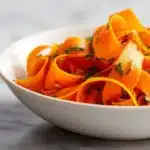
Ribbon Carrot Salad
- Total Time: 13 minutes
- Yield: 4 servings 1x
- Diet: Vegan
Description
A vibrant and easy Ribbon Carrot Salad that combines thinly sliced carrots with a light dressing, toasted sesame seeds, and fresh herbs for a healthy and colorful side dish.
Ingredients
- 4 medium carrots
- 2 tablespoons olive oil
- 1 tablespoon rice vinegar
- Pinch of salt
- Pinch of black pepper
- 2 tablespoons toasted sesame seeds
- Fresh herbs (like parsley or cilantro) for garnish
Instructions
- Wash and dry the carrots, then trim the ends.
- Using a vegetable peeler, create thin ribbons by dragging along the carrot.
- In a dry skillet, toast the sesame seeds over medium heat until fragrant and golden.
- In a small bowl, whisk together olive oil, rice vinegar, salt, and pepper.
- In a large bowl, combine the carrot ribbons, toasted seeds, and dressing; toss gently to coat.
- Garnish with fresh herbs and serve immediately or let sit for 5-10 minutes for a softer texture.
Notes
Feel free to substitute rice vinegar for lemon juice or add in other crunchy elements like nuts or seeds.
- Prep Time: 10 minutes
- Cook Time: 3 minutes
- Category: Salad
- Method: Raw
- Cuisine: International
Nutrition
- Serving Size: 1 serving
- Calories: 150
- Sugar: 5g
- Sodium: 150mg
- Fat: 10g
- Saturated Fat: 1g
- Unsaturated Fat: 8g
- Trans Fat: 0g
- Carbohydrates: 15g
- Fiber: 4g
- Protein: 2g
- Cholesterol: 0mg